

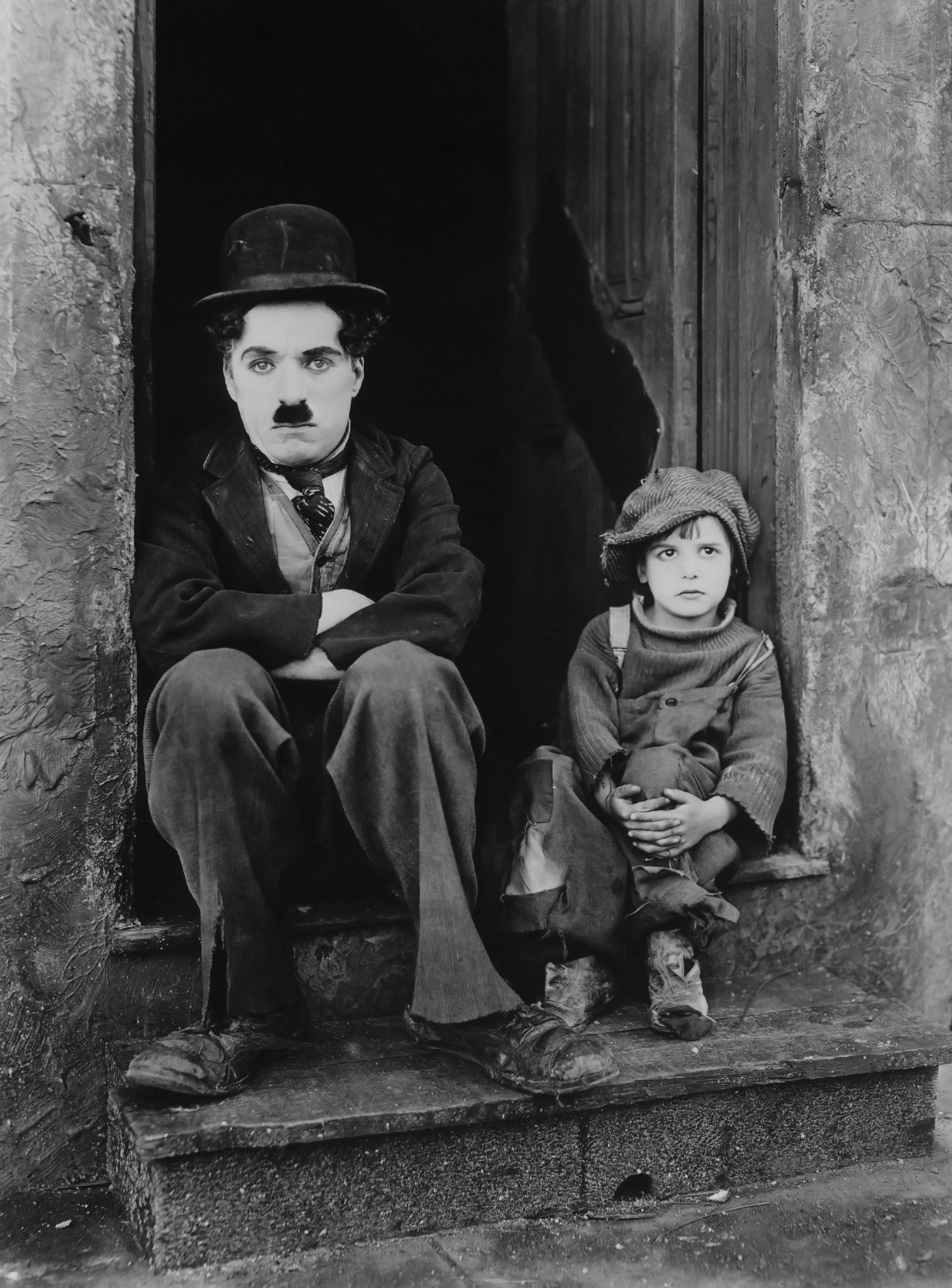
After much thought I painted my face white because I believe that that’s what Charlie would have done. I’m sure you’ve heard the anecdote about Charlie, at the peak of his fame, entering a Charlie Chaplin lookalike contest and finishing third. Biographers doubt that story’s historical veracity but I think it says a lot even if it’s not, strictly speaking, true. To me, it says that Charlie (or the Little Tramp, or, as the French call him, Charlot) is more than Sir Charles Spencer Chaplin, K.B.E., lover of left-wing politics and under-aged girls. No, Charlie’s a real authentic folk hero, belonging to all time, and I try to play him for our time.
When I walk down Hollywood Boulevard I feel a great desire to tell people why I’m playing Charlie. I want to tell them that our time, with its haves and have-nots, isn’t so different from Charlie’s, and that a resourceful tramp with a heart of gold must be a more appropriate hero for it than a psychologically damaged billionaire who dresses up in a ridiculous suit to fight crime. I want to tell them that the message is that the underdog can use his wits and perseverance to overcome any obstacle. I want to tell them that I intend my performance to be a sign of optimism, something desperately needed in this city. Of course, I don’t say any of these things because Charlie doesn’t talk.
Instead I walk out the door into the oven air, catch the 7:53 bus, endure the stares of my fellow passengers, and begin my rounds. It strikes me, as I tread on Doug Fairbanks, senior’s star, that Hollywood Boulevard is a massive graveyard whose mourners have been replaced, for the most part, by Chinese tour groups regrouping outside of the Hard Rock Café. (You can still find real mourners at James Dean’s grave.) A sad Superman walks past me, a heavily made up Marilyn Monroe, a Halloween costume Darth Vader, a low-rent Shrek. I am silent and monochrome, swinging my cane, walking in my oversized shoes. The sounds of the street assault my ears, accompanied by loud talk and louder hip hop emanating from a speaker attached to a kiosk selling iPhone cases, bottled water, and baseball caps reading “I <3 LA.” I see Lillian Gish’s star and wish that I could, in some perhaps spiritual or metaphysical way, shield her from the noise.
At lunchtime I step out of the sun into an old Hollywood hotel. As my eyes adjust to the relative darkness I walk through the art deco lobby into the restaurant and take a seat at the same table Charlie sat at and silently order my cocktail and lunch. I am unfazed by stares from other tables. A man in a suit leans in towards his wife or girlfriend and, I presume, tells her who I’m supposed to be. After the waiter arrives with bread and butter I perform the “dance of the rolls” for the amusement and edification of those around me. Pepe, my favorite waiter, comes to my table and regales me with tales of Old Hollywood, to which I respond with gestures and facial expressions.
After lunch I walk back into the light and heat. I look down Hollywood Boulevard and see another monochrome man amidst the urban congestion. I cross the street to get a closer look at him, almost getting run over by an overzealous biker in the process, and see that he is wearing a pork pie hat. He is, of course, playing the variously-named hero of Buster Keaton films, the one who’s too occupied with his immediate task to notice the world falling apart and who extricates himself from any situation through sheer resilience. He doesn’t smile, being an avatar of the Great Stone Face, but looks at me in a moment of mutual recognition by two kindred souls. Neither of us says a word. And then a kid in shorts breaks our silent communion by running between us and yelling, “Hey Jimmy, I’m gonna take a selfie with Hitler!”
Author’s note: I wrote “Charlie” during a burst of creative energy in the summer of 2015, right before I left for my year in England. I wanted to write a few short stories about the world I grew up in before I left it, stories that would capture some of the people, places and experiences that seemed quintessentially Southern Californian to me. “Charlie” was inspired by the street entertainers on and overall strangeness of Hollywood Boulevard; I tried to imagine why someone would impersonate Charlie Chaplin almost a century after his silent movie heyday.
Your thorough descriptive visual had me in "faux" Charlie's shoes. Great write!
This one is probably my favourite of your stories. :)