

Monica Taddei and Luca Zappala both have extensive experience in film and television postproduction. As a designer and modelmaker, Taddei has accumulated a diverse list of credits, from BBC children’s television to John Carter (2012), World War Z (2013) and Hercules (2014). Zappala has worked for more than two decades as a visual effects artist, contributing to films like Inception (2010), Hugo (2011), Harry Potter and the Deathly Hallows – Part 2 (2011), Ex Machina (2015) and T2 Trainspotting (2017). He is also a Lecturer in Film Production, Visual Effects and Colour at University College London.
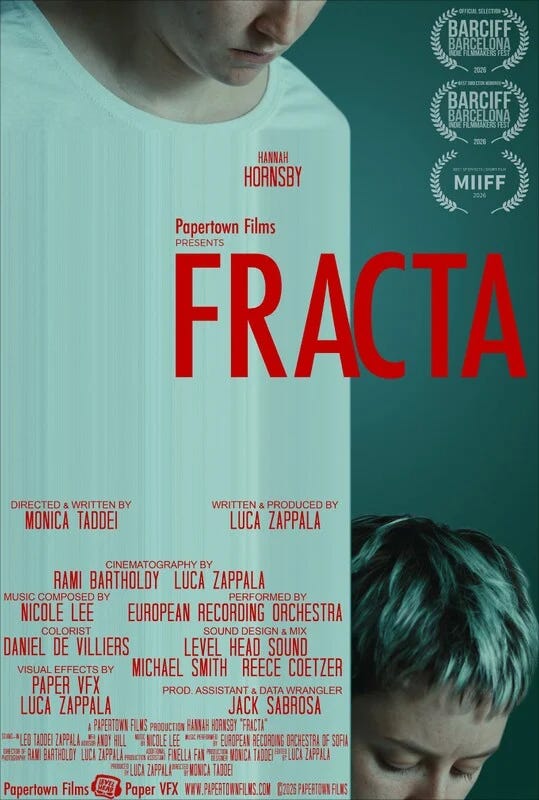
Fracta (2026) represents something new for the duo, who are personal and professional partners: a move above the line, their debuts as a writer-director (Taddei) and a writer-producer (Zappala.) I caught up with the duo last month to discuss this eerie, haunting short film, which was nominated for Best Short Film and Best Director at the Barcelona Indie Filmmakers Fest.
The 2023 Writer’s Guild of America (WGA) strike catalyzed Fracta. As Taddei told me, the sudden availability of so many talented, experienced film professionals provided a “small window of opportunity” that might never happen again. Capitalizing on this opportunity, they wrote a script for a claustrophobic chamber piece.
Since they met as animation and visual effects students two decades ago, the duo have both been fascinated by representing solitude on film; both made student films about that topic. Drawing on their experiences during the COVID-19 pandemic, they wrote a film that, as Taddei told me, is
about isolation and what it entails. We did not want to talk about intentional solitude; instead, we wanted to focus on solitude created by adverse circumstances. The idea is that your living quarters become a map of your daily life, movements, and endeavors, and that you are just floating through life, gliding on the surface. In all of this, COVID is not overtly and obviously invoked, but it is implied.
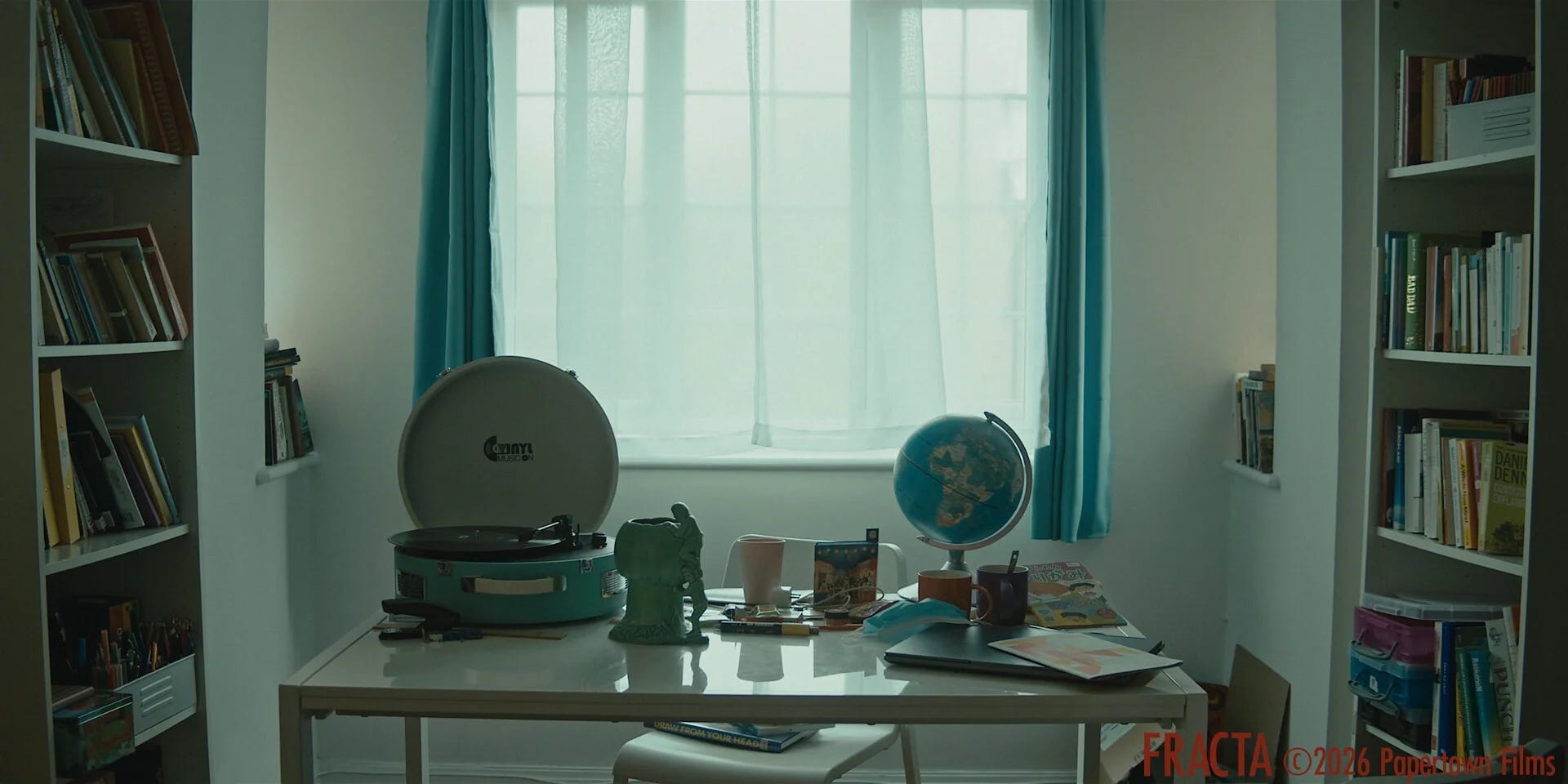
Other memories also informed Fracta. Taddei, the daughter of two antiques dealers, told me that growing up “among vintage and antique objects” inspired her to become both a professional 3d modeler and a collector. Antiques, she told me, can be “carriers, vehicles of stories, books waiting to be read, especially if they are anthropomorphic or zoomorphic.”
While the film’s human cast consists of a single name, its art direction includes an eclectic group of vintage toys, sourced from Taddei’s own collection, whose unblinking eyes add an eerie presence. The most unnerving moment in Fracta is punctuated by cuts to closeups of these toys — a small tin duck, a pie-eyed Kewpie with long eyelashes — that seem like watchful and perhaps even suspicious observers.
Another piece, a green vintage vase with two pixies, served as a visual touchstone for the whole project. In Taddei’s words,
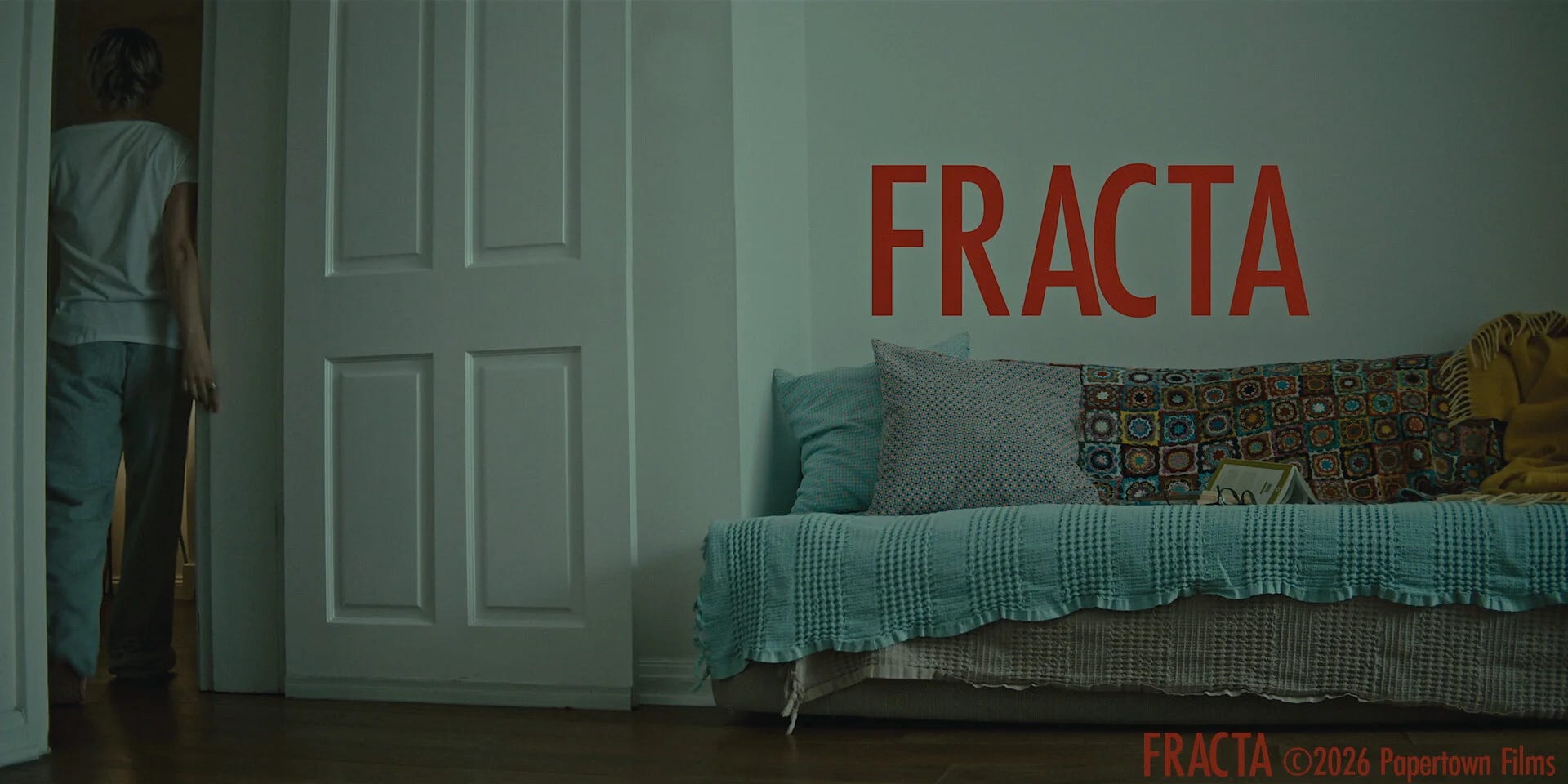
we established two color schemes for the living room and corridor, with a mustard variation for the nighttime corridor to alter the theme. Since development, the vision was dramatic contrast with the soft shadow Renaissance quality of shows such as Fargo and Patriot, especially the mustard yellows with pockets of saturated color.
After writing the script, Taddei and Zappala assembled a creative team including cinematographer Rami Bartholdi, colorist Daniel De Villiers and actress Hannah Hornsby. Hornsby, who has experience in both theater and puppeteering, brought a physical presence that shaped the final film, which is almost entirely wordless. “She immediately understood the mood and theme,” the filmmakers told me. “We pretty much adapted the role around her and her presence.”
After the shoot, Taddei and Zappala drew on their postproduction background to shape the film’s look and feel. “Nearly every shot is a visual effects shot,” Taddei told me; they used extensive color correction to give the film a consistent cold teal and white color palette and digitally removed the set’s doorknobs and light switches to subliminally enhance the claustrophobic atmosphere. (This seamless work would win an award for Best Special Effects at the Montelupo Fiorentino International Independent Film Festival.)
Finally, Taiwanese musician Nicole Lee agreed to compose an original score as her final thesis work at the Film Scoring Academy of Europe; it was recorded by the European Recording Orchestra of Sofia. “What started out scribbled on the back of our son’s homework,” Taddei told me, “ended up with an orchestra recording original music in Bulgaria.”
An international group of people came together to make this claustrophobic film about isolation. As Taddei writes in her director’s statement,
It’s strange how a narrative about being broken and lost, fragmented, lonely, has been cobbled together carefully, knowingly, crafted and glued piece by piece by people scattered across different countries and from three continents.
Fracta won’t be Taddei and Zappala’s last film as writers, producers and directors'; they are currently developing several projects, including multiple short films and their first feature. (You can find them on Instagram at Paper Town Films, and Fracta itself on Film Freeway.)