
Altmanesque 3
McCabe & Mrs. Miller and Images

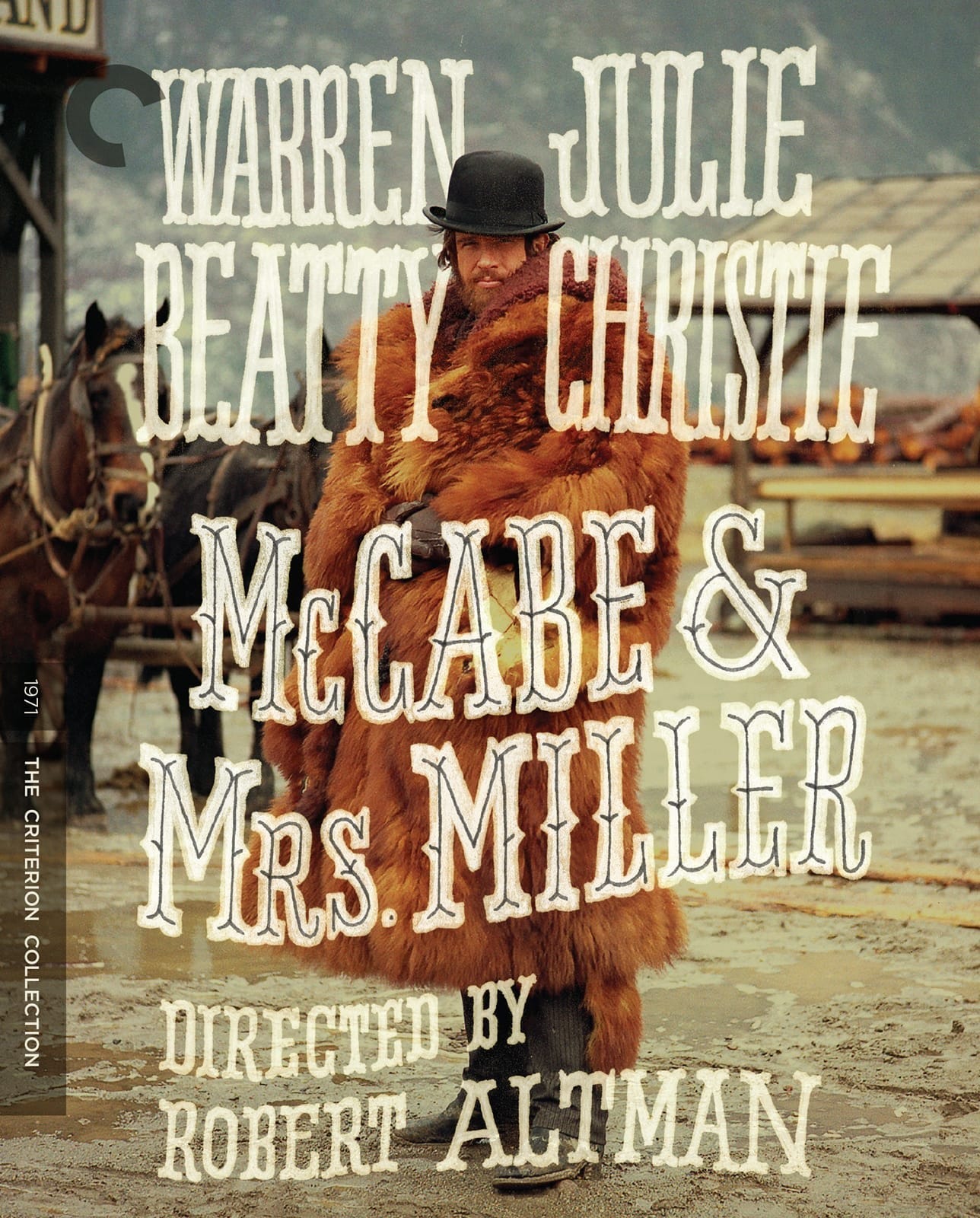
The pipe dreamer is, of course, Robert Altman. McCabe & Mrs. Miller seems so strange because, despite a great deal of noise about the art of film, we are unaccustomed to an intuitive, quixotic, essentially impractical approach to moviemaking, and to an exploratory approach to a subject, particularly when the subject is the American past.
Pauline Kael, review of McCabe & Mrs. Miller
Parts one and two of this series.
Criterion Channel Directed by Robert Altman retrospective.
McCabe & Mrs. Miller (1971)
From my mother I’ve inherited a love of Bob Dylan & The Band: a love of their genre-defying blend of American roots music and of the mythicized, half-historical and half-Biblical world of their cinematic songs, a world that critic (and fellow Substacker!) Greil Marcus aptly calls the Old, Weird America.
McCabe & Mrs. Miller is the closest, fullest cinematic expression of that world, New Hollywood’s Brown Album. It is, as Pauline Kael writes in her rave review, “a beautiful pipe dream of a movie — a fleeting, almost diaphanous vision of what frontier life might have been.”1
Instead of The Band or The Grateful Dead, who explored a similar mythic America via Robert Hunter’s lyrics, Leonard Cohen provides the perfect opening credits song with “The Stranger Song.” Accompanied by just his own acoustic guitar, Cohen sings of a wandering gambler, a figure who is simultaneously a traveler on railroads and highways and “just some Joseph looking for a manger.”
As Cohen plays and signs his sparse, melancholy song, the gambler/conman/possible ex-gunslinger John McCabe (Warren Beatty) arrives at the frontier mining town of Presbyterian Church, WA.2 He wins a hefty sum playing cards at the local saloon and proceeds to invest his winnings in a new career as a pimp. Soon afterwards, the similarly entrepreneurial Cockney immigrant Mrs. Miller (Julie Christie) arrives in town and joins forces with McCabe to create a more civilized establishment with, as she puts it, “class girls and clean linen.”3 Fueled by her business acumen and experience as a madam, their brothel/saloon/casino becomes the town’s most successful business, attracting the unwanted attention of the mining company, which seeks a monopoly over the entire Presbyterian Church economy.
“I certainly didn’t do the film for the story,” Altman tells David Thompson in Altman on Altman. Instead, he saw adapting Edmund Naughton’s 1959 western novel McCabe as a way to create a new cinematic vision of the old west, one focused as much on the setting as on the main characters and their conflicts.
To that end, the film was shot on location in British Columbia, Canada. “There was already a dilapidated town there,” he remembers in Altman on Altman,
with a rooming house for the people who worked in the sawmills. We continued to build up the town as we were shooting. We started with the saloon on the bridge, and as the picture opens you see the mines and other buildings going up – the bathhouse, the whorehouse, and the church.
Building an entire western town, in sequence, over the course of the shoot was not the only major risk taken by Altman and his collaborators. For one, they also acquired, restored and operated an authentic turn-of-the-century steam locomotive. Cinematographer Vilmos Zsigmond deliberately pre-exposed the film to light, changing its color temperature and giving McCabe & Mrs. Miller a faded look reminiscent of 19th century photographs. He also shot much of the film in low light and through fog filters, giving the early saloon scene a dingy, underdeveloped look that almost crosses over into amateurishness.
While Warren Beatty brought star power and charisma to his role, and brought his then-girlfriend Julie Christie to the project, he also clashed with Altman on set, asserting a need for a creative control he would soon find by becoming an actor-producer-director-writer.
The film’s unconventional sound mix continues to divide viewers such as Quentin Tarantino, who famously called its opening “the worst-mixed reel in the history of Hollywood cinema.”
“But you get caught up in the movie and it envelops you,” to quote Tarantino, who has screened McCabe and Mrs. Miller at his Vista Theater. Homemade and rough-edged as it may be, the film becomes a uniquely immersive western as a result of these unconventional choices. While we usually use the word worldbuilding in the context of science fiction and fantasy, this film is a perfect example of the concept; it creates a lived-in fictional world, a community that feels like it exists beyond the four sides of the screen.4 In the words of Roger Ebert,
We spend a time in the life of a small frontier town, which grows up before our eyes out of raw, unpainted lumber and tubercular canvas tents. We get to know the town pretty well, because Altman has a gift for making movies that seem to eavesdrop on activity that would have been taking place anyway.
Indeed, rather than identifying broader concepts or themes, the best way to talk about this movie might involve just listing the little moments that stood out to me:
The way Zsigmond’s snowscapes evoke the colors of Brueghel’s Hunters in the Snow: soft white setting off dark grays, greens and browns.
The way the early saloon scene takes on the chiaroscuro of Van Gogh’s Potato Eaters once the saloon’s one electric light is turned on.
Mrs. Miller scarfing down fried eggs and tea as McCabe looks on and a nameless local fiddler plays “Beautiful Dreamer.”
A whiskey jar skidding along the ice and a dog sniffing a dead body in the snow.
Brief closeups of rainwater dripping from autumn leaves and of icicles hanging from bare branches.
The warm glow of birthday cake candles in Mrs. Miller’s establishment.
William Devane’s lawyer, a framed picture of William McKinley hanging in his office, lecturing McCabe – who faces the very real prospect of death at the hands of the mining company’s hired gunmen – about how entrepreneurs need to stand up to big business.5
McCabe scanning the town for enemies from the belltower of Presbyterian Church’s unfinished Presbyterian church.
Said church catching fire and the entire town – including Chinese miners and Mrs. Miller’s girls – pitching in to put it out.
The devastating ending, a high Mrs. Miller in the opium den entranced by the strange beauty of a Chinese vase.
As Pauline Kael writes, “Lives are picked up and let go, and the sense of how little we know about them becomes part of the texture.”
In addition to impressing critics, this aspect of the film also shaped the future of the western. Heaven’s Gate (1980), the film often blamed for killing New Hollywood, was also shot by Zsigmond and devoted much of its ballooning budget to an even bigger, more elaborate recreation of an old west town.6 Decades later, Deadwood creator David Milch would cite McCabe & Mrs. Miller as the inspiration for his own story of community life in a western town. In a 2006 interview, Milch described Deadwood as being in conversation with McCabe & Mrs. Miller, telling Slant’s Matt Zoller Seitz that “I answer Mr. Altman’s work because I have an affinity for it.”
Part of that affinity is an unsentimental representation of the darker sides of the old west, a hallmark of both works. While the line between the traditional western and the revisionist western is often blurry,7 McCabe & Mrs. Miller falls clearly on the revisionist side, presenting a multiracial, multicultural vision of the old west that acknowledges its violence, drug and alcohol use and exploitation of women and Chinese immigrants.
A vision that nonetheless has a certain dreamlike quality. It is a quintessential piece of Old, Weird Americana and an elegy for it: the old west seen countercultural eyes, deconstructive and mythicizing, a strong candidate for Altman’s best film and one of the best American films of the seventies.
Images (1972)8
And now for something completely different. For their followup to McCabe & Mrs. Miller, much of that film’s creative team – Altman, Zsigmond, production designer Leon Ericksen, actor René Auberjonois, assistant director Tommy Thompson (now in the producer’s chair) and editor Graeme Clifford – flew to Ireland to make a psychological horror movie.
McCabe & Mrs. Miller was a film about a small town, employing elaborate production design and dozens and dozens of unnamed minor characters to create a convincing illusion of community life; Images is a film about isolation, featuring just a handful of onscreen characters and focusing on its protagonist’s inner reality rather than the external social context.
Images was Altman’s first original screenplay, based on a spark of inspiration he had in 1968. In his words,
As I was sitting there myself, this scene came to me: a husband and wife are having an argument, and he is going in and out of the bathroom. And at one point she looks up, and it’s someone she’s never seen before. And that to me is a very frightening idea.9
Inspired by the classic Ingmar Bergman film Persona (1966), Altman expanded his initial idea into another tale of psychological turmoil. It stars Susannah York as Cathryn, a children’s book author suffering from severe paranoia and visual and auditory hallucinations. Her husband Hugh (Auberjonois in his fourth consecutive Altman movie) tries to help by taking her on a spontaneous vacation to rural Ireland, a move that only leads her further down the rabbit hole into paranoia, delusion and surreal, possibly supernatural encounters.
To get into character, Susannah York actually wrote a children’s book, In Search of Unicorns, which, in an exemplary moment of defictionalization, was later published as a real standalone book. In Search of Unicorns has an important place in Images, which begins with Cathryn composing its opening lines. Like the PA announcements in M*A*S*H and the ornithology lectures in Brewster McCloud, spoken passages from the book serve as punctuation between scenes. At times they blend with Zsigmond’s shots of the Irish countryside to create an enchanting, somewhat sinister fairy tale atmosphere.
This atmosphere is enhanced by the film’s score, a collaboration between legendary film composer John Williams and Japanese jazz/prog musician Stomu Yamashta, whose unconventional use of traditional Japanese instruments recalls Tōru Takemitsu’s score for Kwaidan (1965).
Images falls under the umbrella of horror movies that ask whether the creepy events onscreen are real or products of the protagonist’s hallucinating mind. While I’m not sure it’s one of Altman’s best, I think it has something to offer as an atmospheric, unsettling psychological horror movie, and as sign of its director’s willingness to take creative risk after creative risk.10
The next post will begin with 1973 and a very Altmanesque take on another classic film genre.
Words that could also perfectly describe a song like “The Weight” or “The Unfaithful Servant.”
Taken by this opening scene, Stanley Kubrick called Altman and asked how it was filmed. As the saying goes, game recognize game.
As Roger Ebert notes, the change from McCabe (the source novel’s title) to McCabe & Mrs. Miller speaks to the centrality of this business partnership.
Although Altman doesn’t mention it, McCabe’s most direct Old Hollywood ancestor is The Man Who Shot Liberty Valance (1962), the John Ford-John Wayne-Jimmy Stewart elegy for the Old West with the immortal line about printing the legend when the legend conflicts with the truth. That film is also very much about the growth and development of a frontier town. In its second most famous piece of dialogue, Edmond O’Brien’s character gives an impassioned speech about the rough-and-ready western pioneers giving way to law and order, to “the railroads and the people, the steady, hard-working citizens, the homesteader, the shopkeeper, the builder of cities.” McCabe is also about that process.
As (I think) the only actor to appear in movies directed by Altman, Alfred Hitchcock and Christopher Nolan, Devane is a good name to bring up in a game of Six Degrees of Kevin Bacon.
Contemporary critics like the late Philip French picked up on its similarity to McCabe.
For one, the John Waynes and Jimmy Stewarts and Gary Coopers were already playing morally ambiguous antiheroes with violent pasts in the fifties.
This movie is not part of the Criterion retrospective. I watched it on FreeTube, a streaming service hitherto unknown to me.
Altman on Altman.
I’m especially curious to see what the horror-related Substackers in my circle (you know who you are!) make of Images, if they’ve seen it: how it works for them, as a horror movie.
Hi Robert,
I got your note about this post a while ago. I saw both films and a few of Altman's earlier films. I'm trying to process those films and organize my thoughts before I read your specific comments about the films. Sorry, I didn't respond sooner Hopefully, I'll read your analysis soon.
Brilliant work - love the detail in the appendix as well!