
Altmanesque 4
The Long Goodbye and California Split

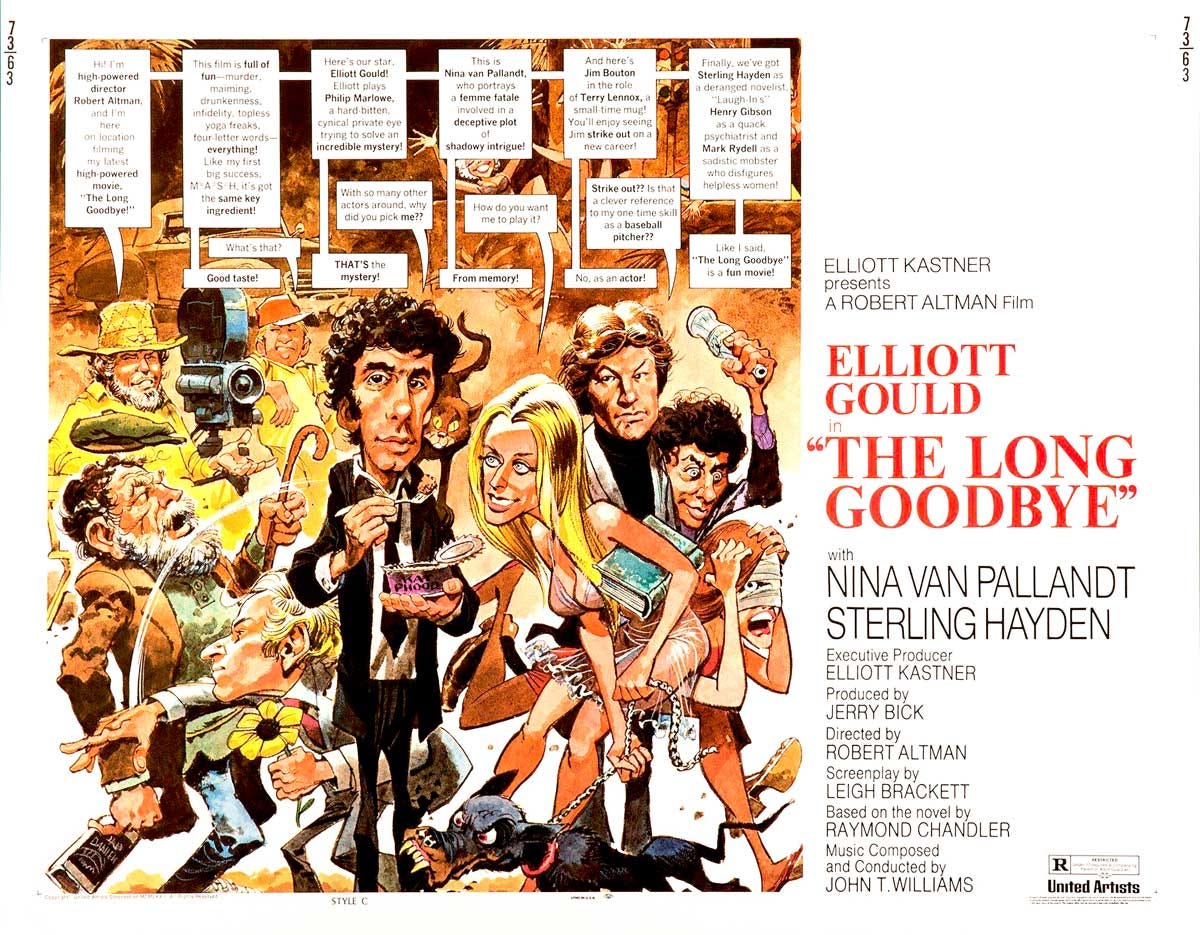
Born one hundred years ago, Robert Altman made movies that play like the cinematic equivalent of jazz—elastic, improvisational, and thrillingly alive to chance and happenstance.
Criterion Channel, Directed by Robert Altman blurb
Parts one, two and three of this series.
Criterion Channel Robert Altman retrospective.
The Long Goodbye (1973)
As previously mentioned, one major strength of the Altman filmography (at least so far) is Robert Altman’s ability to create memorable opening scenes that set a tone for the rest of the movie.
The Long Goodbye (1973) is a perfect case in point. The first thing we hear is “Hooray for Hollywood,” a song that reappears at the end to create ironic, metatextual bookends. Before, during and after the opening credits, we see a 10+ minute sequence of our detective protagonist (Elliott Gould) waking up in the middle of the night, realizing that his cat is hungry and that he’s all out of his cat’s favorite cat food, walking to his car, agreeing to buy weed brownie ingredients for his neighbor while he’s out, driving to the grocery store, discovering that they’re out of his cat’s favorite brand, returning home, and successfully tricking his cat by placing another brand of cat food in the empty tin of its favorite brand.
And Elliott Gould isn’t playing just any detective but THE detective of American literature: Raymond Chandler’s Philip Marlowe, the hardboiled crime novel icon brought to life by Humphrey Bogart in The Big Sleep (1946). This opening, in other words, lets the viewer know right off the bat that they won’t be watching a traditional noir. Like McCabe & Mrs. Miller, The Long Goodbye represents a very seventies take on a classic American film genre.
As with M*A*S*H, Robert Altman did not initiate this project and was not the first choice for director. Producer Elliot Kastner, who owned the screen rights to several Chandler novels, hired The Big Sleep co-screenwriter Leigh Brackett1 to adapt Chandler’s penultimate Marlowe novel The Long Goodbye (1953) and then signed a production deal with United Artists. United Artists offered the director’s chair to The Big Sleep director Howard Hawks and Peter Bogdanovich, who both declined. Altman, the third choice, was impressed by the bleakness of Brackett’s ending and signed on, agreeing to – at least in this instance – curb his tendency to go off-script and stay true to that ending.
In addition to Gould and Brackett, the creative team would include returning Altman collaborators like composer John Williams, cinematographer Vilmos Zsigmond and editor Lou Lombardo. The counterintuitive choice of Gould to fill Humphrey Bogart’s shoes as Philip Marlowe set the tone for a film filled with unconventional casting choices, including MLB pitcher Jim Bouton as Marlowe’s friend Terry Lennox, Danish singer Nina van Pallandt as Eileen Wade and director Mark Rydell as mobster Marty Augustine. And, in only his second feature film, a young, uncredited Arnold Schwarzenegger as a nameless mob enforcer.
If you read reviews of The Long Goodbye, you’ll probably see it identified as something like a missing link between classic Old Hollywood film noir and more contemporary, more comedic “slacker noir” like The Big Lebowski (1998) and Inherent Vice (2014); the creators of both films have pointed to The Long Goodbye as a key influence. This is an accurate observation, especially consider the film’s baggy, meandering first half, featuring an initial adventure in pet ownership.
On this watch, however, I discovered something that escaped me on my first viewing years ago, which is how faithful it is to the spirit of classic noir, to Chandler. Mean Streets (1973), which came out seven months after The Long Goodbye, famously takes its title from the closing passage of Raymond Chandler’s essay “The Simple Art of Murder:”
But down these mean streets a man must go who is not himself mean, who is neither tarnished nor afraid. The detective in this kind of story must be such a man. He is the hero; he is everything. He must be a complete man and a common man and yet an unusual man. He must be, to use a rather weathered phrase, a man of honor—by instinct, by inevitability, without thought of it, and certainly without saying it.
For all his ironic detachment and quick wit, Elliott Gould’s Marlowe is such a man. A caring pet owner, a driver who slows down rather than runs over a dog, a private detective who promises to give his client an itemized list of expenses “so there won’t be any misunderstanding.” Altman and his team referred to the character as “Rip Van Marlowe:” a character living in the seventies but representing the values of a bygone era. One pushed to his absolute limit.
I didn’t pick up on this when I first watched the film2 because it looked and felt so different than Old Hollywood noir; Altman and Zsigmond made the wise decision to not even try to replicate that look. After using the technique of pre-flashing to give McCabe & Mrs. Miller the look of old, faded 19th century photographs, Zsigmond intentionally exposed the film to light both before and after shooting to emulate the soft, pastel colors of vintage California postcards.
Instead of the low-key lighting and deep shadows of classic noir, this is a detective story that truly captures southern California sunlight. A key supporting character, the alcoholic writer Roger Wade (Sterling Hayden), lives in a Malibu beach house and the beach scenes have an incredible, rich glow, especially the almost blinding brilliance of the light coming through the window in an early scene.3
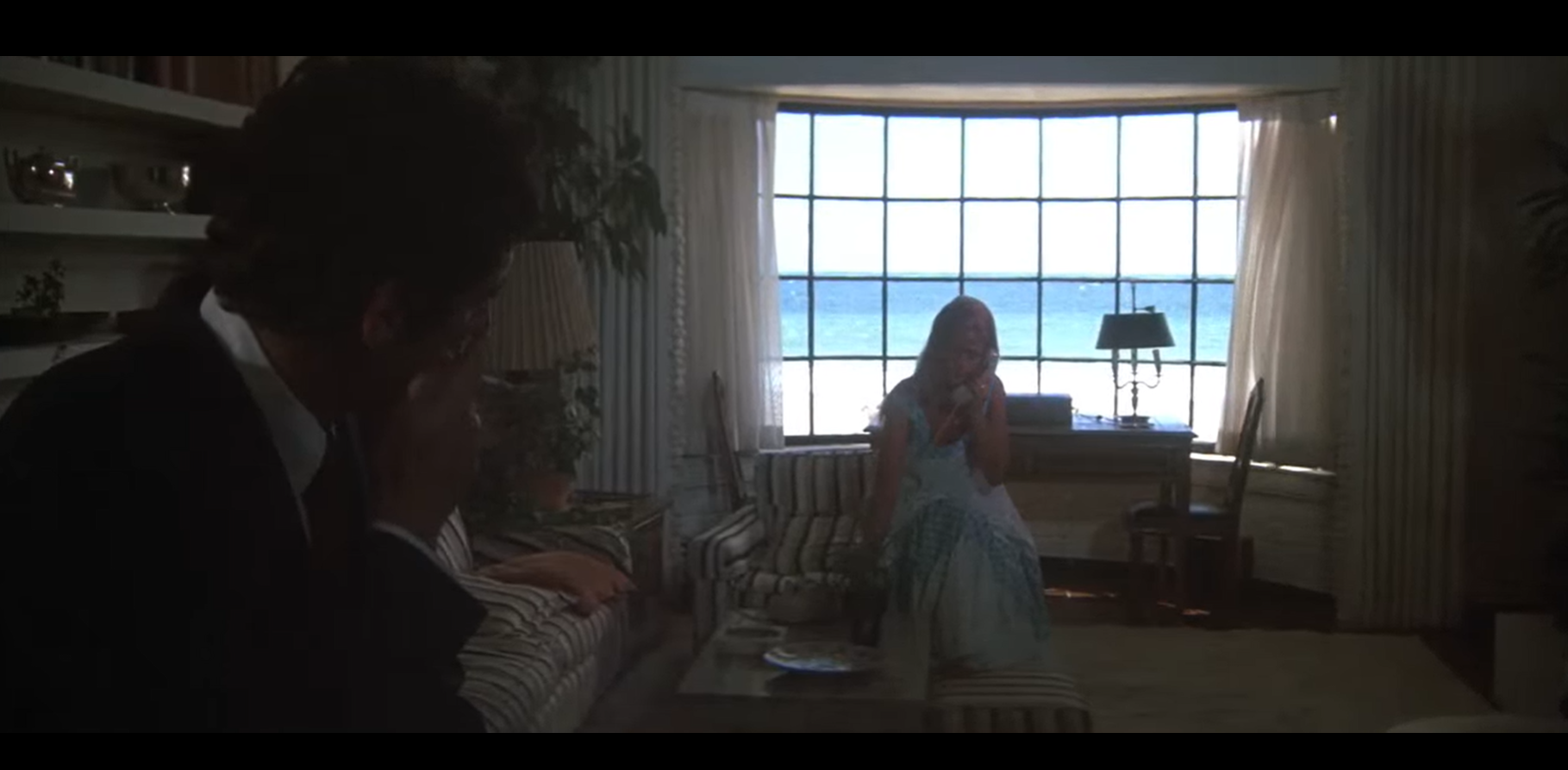
Roger Wade himself is a key ingredient of the film. A literary character that critics have read as both Chandler’s self-portrait and a fictionalization of writers like F. Scott Fitzgerald and especially Ernest Hemingway, Wade and his downward spiral push The Long Goodbye into its dark final act. Altman describes Hayden as “just perfect” for the role in Altman on Altman:
He improvised a lot of his dialogue, and he was pretty well whacked out all the time. He was an alcoholic, and when he smoked grass and had the booze in him he was something else.
As Wade, Hayden can turn on a dime from cool charisma to sheer rage; it’s a truly commanding, scene-stealing performance that makes the most of limited screentime, even if much of it came from the overlap between the role and Hayden’s own lifestyle in the early seventies. And like an archetypal horror movie character, Wade is a harbinger of darkness to come in the film’s endgame.
Like Chinatown (1974), the ultimate neo-noir, The Long Goodbye takes the fatalism of classic noir – and the hardboiled detective as a tour guide through the seedy underbelly of America – to express a post-Manson, post-Altamont, Vietnam War and Watergate-era bleakness.
This a film that begins with cat food and weed brownies and ends with suicide, betrayal, humiliation, threats of mutilation, bodily injury, revenge and death. On this watch I saw the pattern, the slow descent from offbeat stoner slacker detective pseudo-comedy into hell, the way the ending becomes even more vicious, even more cathartic in contrast to the casual beginning. This is the only possible film noir where “I even lost my cat” works as a devastating, darkly funny final line.
The Long Goodbye flopped when it came out in 1973 and received mixed reviews; as Altman notes, critics and audiences expected a Humphrey Bogart Philip Marlowe and did not get that. But it’s gained a well-deserved cult classic status in the past fifty years.
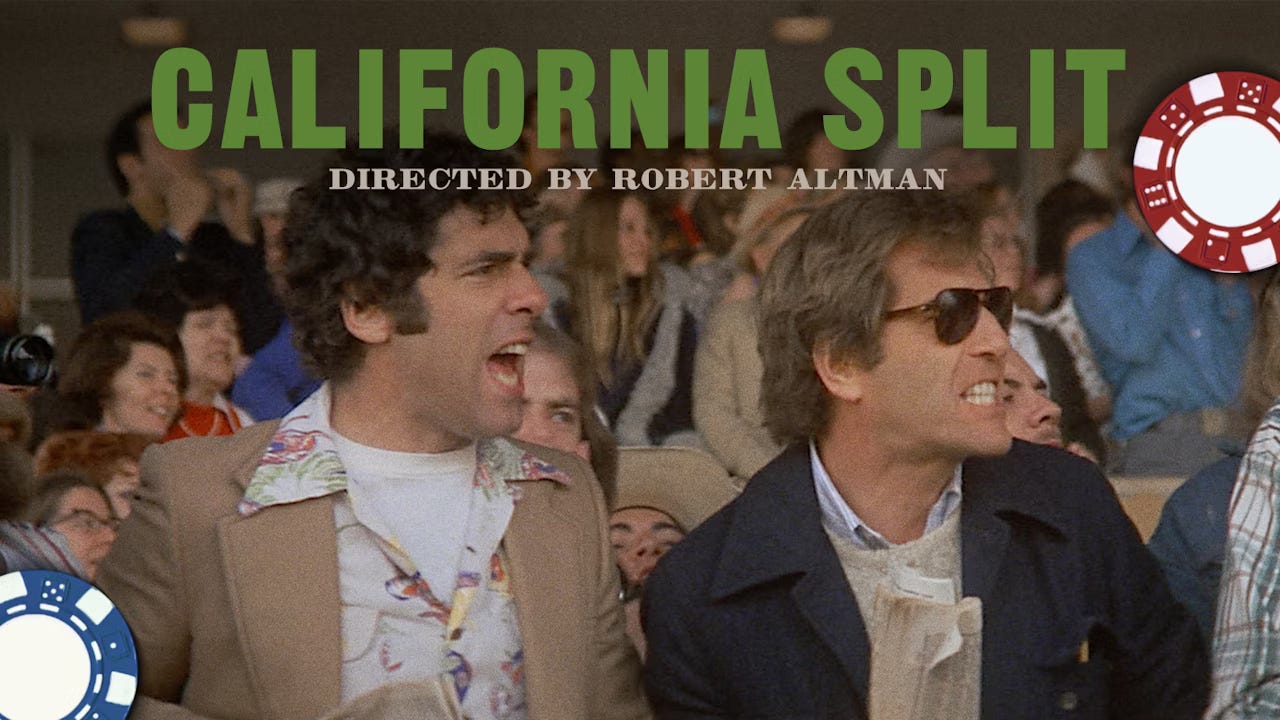
California Split (1974)4
Like The Long Goodbye, California Split was not intended for Robert Altman. Actor/screenwriter/self-described former gambling addict Joseph Walsh wrote the script and developed the project for a young Steven Spielberg, who left to direct The Sugarland Express (1974), his theatrical feature film debut.5 Altman, who came onto the project after Spielberg left, felt a personal connection to its subject matter. “I was a bit of a gambler,” he tells David Thomson in Altman on Altman.
My father was a gambler and I knew a lot of gamblers, and I kind of like that world. I thought those guys I have known were romantic… Gambling is a way out of the security of life, bringing risk back into it.6
Starring Elliott Gould and George Segal as a pair of increasingly compulsive gamblers,7 California Split can be read as an Altmanesque take on yet another cinematic genre, the buddy comedy. Or, to use a 21st century word, the bromantic comedy, as this film’s central plot thread follows the bromance between relatively stable office worker Bill (Segal) and free-spirited, swinging bachelor/full-time gambler Charlie (Gould). After meeting at the poker table and bonding over getting mugged together in the parking lot, Bill and Charlie pursue fun and profit at cocktail lounges, bars, casinos, racetracks and boxing rings, with Bill falling deeper and deeper into Charlie’s chaotic lifestyle – and into debt.
In addition to the bromantic comedy, California Split also exemplifies the concept of the hangout movie as popularized by Quentin Tarantino; Andrew Sarris aptly describes it as taking place in a “rootless, drunken, incoherently improvisational world” in his contemporary Village Voice review. While it does focus on two central characters instead of an ensemble, California Split is hyper-Altmanesque in its relaxed, episodic storytelling, and whether you enjoy it has a lot to do with how much you enjoy hanging out with Bill and Charlie in the smoke-stained, very seventies, very brown world they inhabit.8
While there is a central arc, as previously mentioned, this film is simply not concerned with economic storytelling. It makes time for, among other things, a pickup basketball game, Bill and Charlie eating Froot Loops, Bill and Charlie getting mugged multiple times, and, in an early scene, Bill and Charlie getting hammered and trying (and failing) to name all seven Disney dwarfs. People talk about films having breathing room; most of California Split is breathing room. This casual approach reflects the film’s production, with cast and crew members, especially Gould, gambling on location during breaks.9
But, as with The Long Goodbye, this meandering film gets darker in its last act, which does address the literal and metaphorical costs of its characters’ pursuit of money and pleasure, the ways in which gambling addiction encourages the gambler to bet everything on the hope that they’ll get luck this time. There’s a relatively late scene of Bill daydrinking in a bar and eavesdropping on an arguing couple; Segal effectively communicates his character’s worry and isolation without words. Josh and Benjamin Safdie have cited this aspect of the film as a key influence on Good Time (2017) and Uncut Gems (2019); in their words, all three films are about “winners who don’t win.”10
As with The Grateful Dead, this film’s spontaneous, improvisation approach to performance coexists with a cutting-edge approach to sound design. California Split was the first mainstream, non-Cinerama film to feature an eight-track soundtrack; its sound team used up to 11 microphones to record casino, racetrack and boxing ring soundscapes. While there are some distracting jumps in volume early on, and a few moments of muffled dialogue,11 the film’s sound design is generally effective.
Its opening, for instance, effectively juxtaposes a square, fifties instructional film narrator expositing on the rules and etiquette of poker with the murmuring, clacking chips and arguing gamblers of a real casino in the seventies. Later scenes capture the sheer noise, the sensory overload, of public places in a way that very few films do.
In his introduction to Altman on Altman, the British film critic David Thomson argues that Altman used his free-roaming camera and multiple microphones to “convey the fleeting nature of life as we experience it, with all the frustration of its lack of precision and the pleasure of happy accidents.” For good and bad, California Split conveys that particular aesthetic as much as any Altman movie.
Leigh Brackett (1915-1978) is possibly best remembered as a pioneering American woman science fiction writer; her pulp magazine tales of adventures on alien planets earned her the nickname “Queen of Space Opera.” In Hollywood, she had a decades-long collaboration with Howard Hawks, adapting The Big Sleep (1946) with William Faulkner and Jules Furthman and writing or cowriting the westerns Rio Bravo (1959), El Dorado (1966) and Rio Lobo (1970). Her final, posthumous screen credit was a return to space opera: Star Wars: Episode V – The Empire Strikes Back (1980) which she contributed to in the final days of her battle with cancer.
And, for what it’s worth, didn’t really connect to the film itself.
Another visual that stuck out to me comes from Marlowe’s first trip to Mexico to investigate the disappearance of Terry Lennox. As he meets with a local official, the camera pans to a funeral procession in the streets and follows it to the local cathedral. An event that doesn’t play into the plot but contributes to the atmosphere.
Between The Long Goodbye and California Split, Robert Altman directed Thieves Like Us (1974), an adaptation of the novel of the same name by Edward Anderson which had previously been made into the Nicholas Ray movie They Live by Night (1948). Thieves Like Us, which stars Keith Carradine and Shelley Duvall, is not part of Criterion’s retrospective and not available in anything resembling good quality streaming video. Here’s hoping for a future Criterion restoration.
Duel (1971), a made-for-tv movie, would later receive a theatrical release.
Two pages later, Altman acknowledges his own life as a compulsive gambler, which hit a nadir in the eighties.
The supporting cast includes future Nashville (1975) actress Gwen Welles and, in his second feature film role, Jeff Goldblum in a bit part.
This is a gambling movie that ends with a road trip to Reno, not even Las Vegas. There is zero glamour here.
I’d have to think it was also an influence on Altman protégé Paul Thomas Anderson’s debut feature Hard Eight (1996), another film very much about the moment-to-moment life of gamblers.
In the words of Paul Thomas Anderson, “I also think as the master who sort of invented that multi track thing–we here are definitely the children of that, but thankfully have learned, I think, from those mistakes. Because there are some of those films–there are some times in California Split where you’re like, Good try but I can’t hear a fucking word.”
Fantastic essay about a true original. Every time I watch one of his movies there comes a point where I forget that he’s subverting and deconstructing a particular genre, and simply get lost in his world. Maybe that is the wrong way to experience his work, but his voice was strong enough and strange enough that his movies can stand on their own. The Long Goodbye certainly can; most neo-noirs have trouble.
Nice take; something between a review and an essay. I was one of those who could not get past Elliot Gould in The Big Sleep. I also never saw California Split. I'm going to watch them both. Thanks.