
Altmanesque 6
3 Women and Quintet

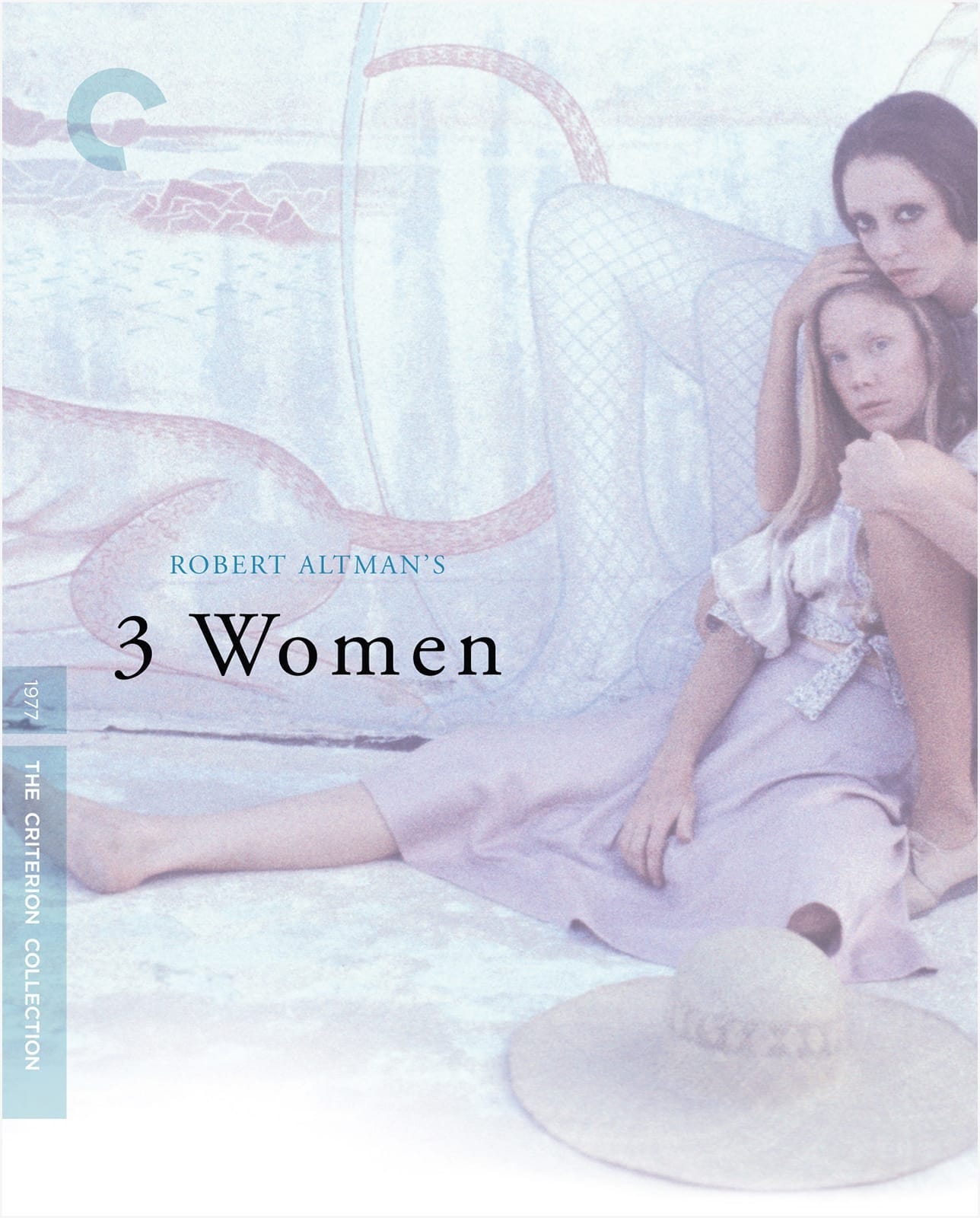
Altman experts have tried to sum up his overall approach in various pithy phrases. Robert Kolker speaks of “radical surfaces,” for instance, while Robert T. Self invokes “subliminal reality.” While both formulations are useful as far as they go, 3 Women eludes all efforts at definitive interpretation.
David Sterrit, Criterion Collection essay
Parts one, two, three, four and five of this series.
Criterion Channel Directed by Robert Altman retrospective.
3 Women (1977)
For Robert Altman, the seventies were a fertile creative period, a time of experimentation and deliberate rule-breaking that created a strong body of work. With the exceptions of M*A*S*H (1970), Altman’s only real blockbuster hit, and Nashville (1975), it was also a period of critically acclaimed commercial flops that burned bridges with producers and studio executives.
After Buffalo Bill and the Indians, or Sitting Bull’s History Lesson (1976) became Altman’s most expensive flop, only one Hollywood executive was willing to take a gamble on him: Fox’s Alan Ladd Jr., whose previous bet on Star Wars (1977) was about to massively pay off. Altman would remain with Fox for five films; the relationship would end after Ladd Jr. and two other Fox executives left to form The Ladd Company.
3 Women came to Robert Altman in a dream. In his words,
I had a film cancelled on me at Warner Brothers. I needed to make a film badly, and then my wife Kathryn got very sick. We took her to the emergency hospital at four in the morning and it seemed so serious at the time, though it all turned out to be fine in the end. But I returned to my house on the beach in Malibu and went to bed feeling kind of desperate, and I dreamed I was making this film. I dreamed the title, the location, and that there were three women, and I knew two of the cast, Shelley Duvall and Sissy Spacek.
He notes that his imagination likely transformed real-world beach sand into a dream desert. Starting with these elements and the vague dream-idea that the movie should be about personality theft, Altman immediately sent his associates Tommy Thompson and Bob Egenweiler to Palm Springs to scout location and then personally pitched the movie to Ladd Jr, who agreed to make it for a budget of $1.5 million.
As the title suggests, 3 Women represents a 180 degree turn away from the large ensemble casts of Nashville and Buffalo Bill. The production was nonetheless quintessentially Altmanesque, involving what Altman would later call an “organic process” of taking inspiration from Palm Springs and Desert Hot Springs locations and encouraging actorly improvisation. Pinkie (Spacek) and Millie (Duvall) work at a geriatric health spa because Altman and associates just happened to discover that location; as Altman notes in the commentary, they could have just as easily been waitresses if the production team had happened upon a picturesque diner out in the desert.
As with Altman’s collaborations with Vilmos Zsigmond, 3 Women has a distinctive look because of visual experimentation; cinematographer Chuck Rosher Jr. intentionally overexposed the film and then adjusted it in the lab to give it a desaturated image. This technique, combined with Bodhi Wind’s original paintings and Scott Bushnell’s production design (both of which focus on what Altman calls the “desert colors” of yellow, pink and purple) gives the film a distinctive color palette. Rosher also frequently shot through water — through swimming pools, Millie’s fish tank, and a seventies wave motion machine — to add another layer to the visual style.1
Sometimes, in very special cases, you remember specific colors from movies: the green light coming through the window in Vertigo (1958), the clean, cold fluorescent white of the spaceship interior in 2001: A Space Odyssey (1968), the red glow of Darth Vader’s lightsaber. 3 Women is such a film, with the lemon yellow and white of Millie’s apartment and the pale blue, tan and pink of the surreal murals as two unforgettable cinematic color palettes.
Altman did manage to turn the film in just slightly over budget. It premiered in April 1977 and screened in competition at Cannes, where Duvall tied for best actress. While it did receive some positive reviews, 3 Women failed at the box office and disappeared from public consciousness until Criterion put out a restored, remastered DVD in 2004. That release led to a reevaluation, to a cult classic status that has increasingly become an unqualified classic status; 3 Women received 10 votes in the 2022 BFI/Sight and Sound poll, tying it for 373rd overall and third in Altman’s filmography.2
3 Women was (I think) the second Altman movie I ever saw, after The Player (1992). It hooked me immediately: the opening pan across Bodhi Wind’s painting of labyrinths and strange mythical creatures,3 combined with Gerald Busby’s atonal score, created an atmosphere that continued into a weirdly ominous opening scene of elderly people doing physical therapy in an indoor swimming pool.
If you want to get inebriated, google 3 Women and take a drink every time you come upon a review or article or social media post framing it as the middle part of a thematic trilogy that begins with Persona (1966)4 and ends with Mulholland Drive (2001).5 Like those films, 3 Women is about what Altman calls personality theft, about two female protagonists whose identities shift and merge.
In this case, that central relationship is between two coworkers at the geriatric health spa: naïve, childlike newcomer Pinkie (Spacek) and experienced chatterbox Millie (Duvall), who takes Pinkie under her wing and subjects her to verbose lectures on topics ranging from how to win a man to the proper way to prepare tuna sandwiches. The fact that they are both Texans in California legally named Mildred suggests a doppelganger relationship that intensifies throughout the film. In his director’s commentary, Altman compares Pinkie to an alien observing and mimicking human behavior; one could read the film as being about that imprinting process.
3 Women is a difficult film to write about because so much of its impact comes not from specific scenes or lines of dialogue but from the gestalt, from the eerie, oneiric, unheimlich atmosphere it creates. From the sense that there is something primal and even ritualistic going on, culminating in Pinkie, Millie and painter Willie (Janice Rule) becoming a surrogate family, a trio evoking both the Freudian Id-ego-superego and the pagan maid-mother-crone triple goddess.
On subsequent viewings, I can attribute much of this weirdness to a series of archetypal, elemental contrasts. Between water, the source of life – Altman refers to womb imagery in his commentary – and the barren desert, between the young women who work at the health spa and its elderly patients, between Millie and Pinkie, between a set of physical doppelgangers (a pair of identical twins who work at the health spa) and Millie and Pinkie as psychic doppelgangers, between masculine and feminine, birth and death. But the film’s strength is that some weird, nameless element remains unaccounted for even after an analysis like this.
If you’re reading this, you’ve probably seen your share of heavy-handed dream sequences in movies. You’re probably very familiar with the time-honored cliché of comparing movies to dreams, with the idea of Hollywood as a dream factory. I’ve never dreamed of an action set-piece à la Inception (2010), but I can point to 3 Women as a rare authentically dreamlike film.
Quintet (1979)
After the war movie, the western, the psychological horror movie, the film noir and the buddy comedy, Quintet represents Robert Altman’s take on yet another genre, post-apocalyptic science fiction. Before discussing this particular film, I think it might be useful to briefly consider this subgenre more generally, the question of what draws us to stories set after the fall of civilization.
The most obvious answer – and possibly the best – is that these stories speak to some of the darkest fears of a post-Hiroshima and Nagasaki world. I think of the famous, probably apocryphal Albert Einstein quote about World War IV being fought with sticks and stones. For people rebuilding from the rubble of a bombed city, the world must feel pretty post-apocalyptic.
Altman himself touches on another answer in Altman on Altman. Interviewer David Thompson compares Quintet to a western and Altman responds “yes, it’s a Western or a samurai adventure. But I really see it as a fairy tale.” If you want to tell a story about a lone hero or fellowship of heroes on an epic journey, you generally wouldn’t set that story in the contemporary world, at least not in the contemporary first world with its controlled, guarded spaces and cities linked by railroads and airports. A post-apocalyptic scenario puts blank spaces and wild, uncontrolled, undiscovered places bank on the map.
It also presents a defamiliarizing, uncanny look at familiar places. Quintet leans into this last aspect of post-apocalyptic fiction. Altman and his team shot on location at the abandoned Montreal Expo 67 site in the dead of winter, extracting significant Unhemlichkeit from a snowed-in, icicle-covered, almost empty version of a place designed for large crowds of people. There’s a brief, early scene of seal hunter Essex (Paul Newman) and his romantic partner Vivia (Brigitte Fossey) walking through an abandoned train station that has a similar effect. When you think of a train station, you imagine it bustling with people, loud with conversations and footsteps and train engines and announcements of arrivals and departures.
The best aspects of Quintet are these unremarked-upon details that imply a wider world and an unseen history. Its basic conceit is that, in a far-future earth undergoing a new ice age, the last remnants of humanity spend all their time playing a five-sided board game called Quintet. Holed up in the ruins of Expo 67, which they refer to as a hotel, they pay no attention to the wild dogs that roam around the outskirts of their settlement, eating the frozen dead bodies of former residents. Later on, characters walk past – but do not mention – a life-sized sculpture of wild dogs scavenging on a dead body, as if a sculptor from an earlier, somewhat more functional version of this society decided that that image would be a good representation of the zeitgeist.
The plot, such that it is, concerns Essex returning to civilization after a long and ultimately unsuccessful seal hunt and discovering that the game of Quintet has turned into a game of death, with losers getting killed by an unknown assassin. This might sound like an entertaining, suspenseful snowbound movie à la The Thing (1982) or The Hateful Eight (2015),6 but Quintet is a bleak, somber, often quiet chamber piece.
Pauline Kael – who had praised Altman’s earlier films – compares Quintet to “a Monty Python show played at the wrong speed,” which is right on the money. The Pythons would have found a rich vein of dark, absurdist, satirical comedy in a story about people dressed in silly costumes playing a deadly board game as humanity dies around them. But Altman really doesn’t. Other critics have compared Quintet to Zardoz (1974), the notorious John Boorman-helmed flop featuring Sean Connery in a matching red loincloth and bandolier combo. While I can see the similarities, that movie is so ridiculous, so over-the-top in its absurd dialogue and overall pretention that it becomes campy fun. Quintet does not.
3 Women took after Persona; Quintet7 sometimes feels like an odd, seventies science fiction take on the most iconic scene in Ingmar Bergman’s filmography, the existential chess game against Death in The Seventh Seal (1957). In Altman on Altman, Robert Altman connects the film’s bleak tone to the deaths of his mother and father; his father died of cancer just before Altman left for the location shoot in Montreal. This is a mournful film, a film about the slow death of everything.
It plays against against some of Altman’s greatest strengths. This is a film about detached, disconnected, hopeless people, not an Altmanesque community. From M*A*S*H (1970) onward, his films feature naturalistic dialogue, with characters interrupting each other, talking over each other, stumbling over their words and generally talking like real human beings. Quintet, on the other hand, features stilted, deliberately archaic/futuristic dialogue. Because of this, Quintet — like Buffalo Bill — features mediocre performances from actors capable of much more. I’ve seen Newman, Andersson, Vittorio Gassman and Fernando Rey give fantastic performances in other films, but they all come across flat here.
In previous posts, I’ve praised Altman and his cinematographers, especially Vilmos Zsigmond, for their visual experimentation, which gave movies like McCabe & Mrs. Miller and 3 Women unique visual styles. In Quintet, cinematographer Jean Boffety often combines soft focus with corner blurring/vignetting to create the effect of looking at the film through a cold, frosted window. While it occasionally works, giving the snowy settings a dreamlike feel, its overuse makes it come across as more of a heavy-handed gimmick than an interesting artistic decision.
Quintet failed at the box office and with critics. Quentin Tarantino would later call it “terrible, boring and pointless” in Cinema Speculation and it’s generally placed in the lowest tier of Altman’s work. I usually don’t like using the word self-indulgent to describe a film or filmmaker, in part because anyone who demands that other people spend millions of dollars and thousands of hours on realizing their personal creative vision probably has some level of self-indulgence. But this film – directed, produced and cowritten by Altman – could have benefited from an outside producer willing to say no, willing to ask him and his collaborators to spend more time on half-baked script ideas.
Standing almost alone, critic Carlos Valladares goes to bat for Quintet in a recent Criterion article, calling it a “fearless exploration of how nihilism, inaction, and lovelessness threaten the human condition.” I can imagine the right person, in the right mood, appreciating this cold, somber film about the world ending with a whimper.
But I can also image the postapocalyptic movie some other version of Robert Altman made in alternative universe, an Altmanesque ensemble piece about a group of survivors on an epic journey or staying put and building a new community.8 And I’d probably rather see that movie.
Altman describes 3 Women as a much more composed film than previous efforts like Nashville.
3 Women finished third among Altman’s movies, behind only Nashville (33 votes, tying for 116th places) and McCabe & Mrs. Miller (11 votes, tying for 339th place.) Eleven Altman films received at least one vote in the poll, with Short Cuts and The Long Goodbye also finishing in the top thousand.
Altman calls these creatures “sexual monsters” in his director’s commentary.
In the commentary, Altman credits Bergman with giving him “the confidence to be quiet” and names Bergman, Akira Kurosawa, Federic Fellini and John Huston as four key influences on his work.
As I mentioned in the introduction to this series, 3 Women is the rare film that can be accurately described as both Lynchian and Altmanesque.
The trailer is clearly trying to sell it as a horror/thriller movie akin to The Most Dangerous Game (1932).
Which costars Bergman regular Bibi Andersson.
Imagine what Altman could have done with source material like The Stand or Earth Abides.
You are really knocking it out of the park with these Altman dives. I'd enthusiastically purchase and read an entire book composed of them.
3 Women— tough film to write about, and you did a beautiful job. One of his least on-brand movies, but when I first saw it on criterion I really loved it. One of the weirder Hollywood films, I’d say.