
Altmanesque 10
The End of the Eighties

It’s really like building a sandcastle. I use this metaphor a lot for myself. It’s the doing the work that is the art and that is the reason for the art and that is the fun of it. You get your friends together and you build a sandcastle and the tide comes in, and twenty minutes later the sand is all smooth everything has gone. That castle remains only in the memories of the people who did it, really, not so much the people who saw it.
The series so far:
Introduction, Countdown, and That Cold Day in the Park
McCabe & Mrs. Miller and Images
The Long Goodbye and California Split
Nashville and Buffalo Bill and the Indians, or Sitting Bull’s History Lesson
Come Back to the Five and Dime, Jimmy Dean, Jimmy Dean and Streamers
Robert Altman on the Criterion Channel
Beyond Therapy (1987)1
Robert Altman got many cinematic at-bats in his long career, with quite a few strikeouts, pop flies and bunts alongside home runs like Nashville (1975). Throughout this series, I’ve criticized films like Buffalo Bill and the Indians, or Sitting Bull’s History Lesson (1976) and Quintet (1978) while also acknowledging a few stand-out moments and something original and idiosyncratic. Beyond Therapy is Altman’s worst film, at least among theatrically released films currently available via streaming, and the only film of his I’d describe as unequivocally terrible.
By the late 1980s, Altman had burned bridges with seemingly every American movie studio save for one: New World Pictures, which was founded by Roger Corman in 1970. While Corman sold the company in 1983, his sensibility and no-frills approach to filmmaking lived on at the studio, which survived into the 1990s by making low-budget horror movies and the occasional lowbrow comedy. It’s an odd fit for Robert Altman, and so is the source material.
Beyond Therapy was Altman’s last stage-to-screen adaptation and last feature film of the 1980s. Based on Christopher Durang’s 1981 off-Broadway farce of the same time, and follows the courtship of neurotic, bisexual Bruce (Jeff Goldblum2) and equally neurotic Prudence (Julie Haggerty). Hijinks ensue as Bruce’s jealous lover Bob (Christopher Guest), Bob’s mother Zizi (Geneviève Page), and Bruce and Prudence’s dysfunctional psychotherapists (Glenda Jackson and Tom Conti, respectively) attempt to interfere with their budding relationship.
Beyond Therapy fails in the most basic, uninteresting way. It’s an unfunny comedy, with jokes about sexuality and patient-client relationships that do not land in 2026. In a 2024 post, I discussed the aesthetics of the so-bad-it’s-good movie and what differentiates it from the merely bad movie; Beyond Therapy falls into the latter category and I don’t see people enjoying it ironically.
I count one funny moment: Goldblum’s character talking about seeing a screening of The Tree of Wooden Clogs (1978) and then coming home to have sex. Because this is such a random — or, to use a 2020s-ism, extra — cinephile reference, because the idea of a 3 hour-long, neo-neorealist arthouse film about the socioeconomic struggles of 19th Italian peasants as a date movie is absurd enough to make me chuckle. Otherwise, it’s a tedious 90-odd minutes of jokes that either simply misfire or come across as tasteless or even offensive, especially attempts to mine comedy from therapist-client sexual relationships.
Furthermore, it’s an unfunny comedy that wastes a talented cast. If you’ve ever seen Christopher Guest’s performances in This Is Spinal Tap (1984) or his own directorial efforts like Waiting for Guffman (1996) and Best in Show (2000), you know that he can be an incredible improvisational comedic actor. On paper, he seems like a perfect fit for Altman’s style of directing; his own films have something of an Altmanesque sensibility. But he falls flat as the jealous gay lover and his costars don’t fare much better.
Julie Haggerty is funny in Airplane! (1980) and excellent opposite Albert Brooks in Lost in America (1985); the late Glenda Jackson is a Triple Crown of Acting-winning actress; Tom Conti is an award-winning actor with a long and successful career in film, television and live theater; Jeff Goldblum has an odd charisma that’s inspired multiple internet memes; and so forth. This is a cast that could and should carry a comedy, but the lines they deliver and situations they find themselves in are just too unfunny, too off-putting. I would love to have seen Altman and this cast collaborate on some other movie adapted from some other source material.
Beyond Therapy is still performed onstage, although I have hard time imagining 21st century audiences going with a lighthearted sex comedy featuring a wacky psychotherapist who crosses multiple legal, ethical and professional lines to sleep with his female clients. Perhaps the right director and cast, taking the right approach, could make the play work: Altman and his team do not.
I tend to think of Altman as something of an anti-Stanley Kubrick, someone much less interested in meticulous research and planning than in on-set experimentation in collaboration with actors. A composer painstakingly rewriting a symphony vs. a jazz improviser jamming.
At its best, Altman’s approach creates an incredible, naturalistic cinematic world with the spontaneity and awkwardness and untidy vitality of real life. At its worst, as in Beyond Therapy, it leads to half-baked projects from a director whose lack of studio support and reputation as box office poison meant that he couldn’t spend years choosing and then developing the perfect project.
Both directs are united in their willingness — or, better yet, their eagerness — to take on new creative challenges. While this series focuses on Robert Altman’s theatrical films, he did grow and experiment as an artist during his wilderness years in the eighties: through live theater, minimalistic film adaptations of plays, television and opera, which brings us to Aria (1987).
Aria (1987)3
One of my all-time favorite films is Fantasia (1940), Disney’s grandiose, sublime, avant-garde and kitsch anthology of animation inspired by classical music.4 When I first read about Aria (1987), a film I had never heard of prior to this Altman retrospective, I was intrigued because it seemed like something of a live-action Fantasia.
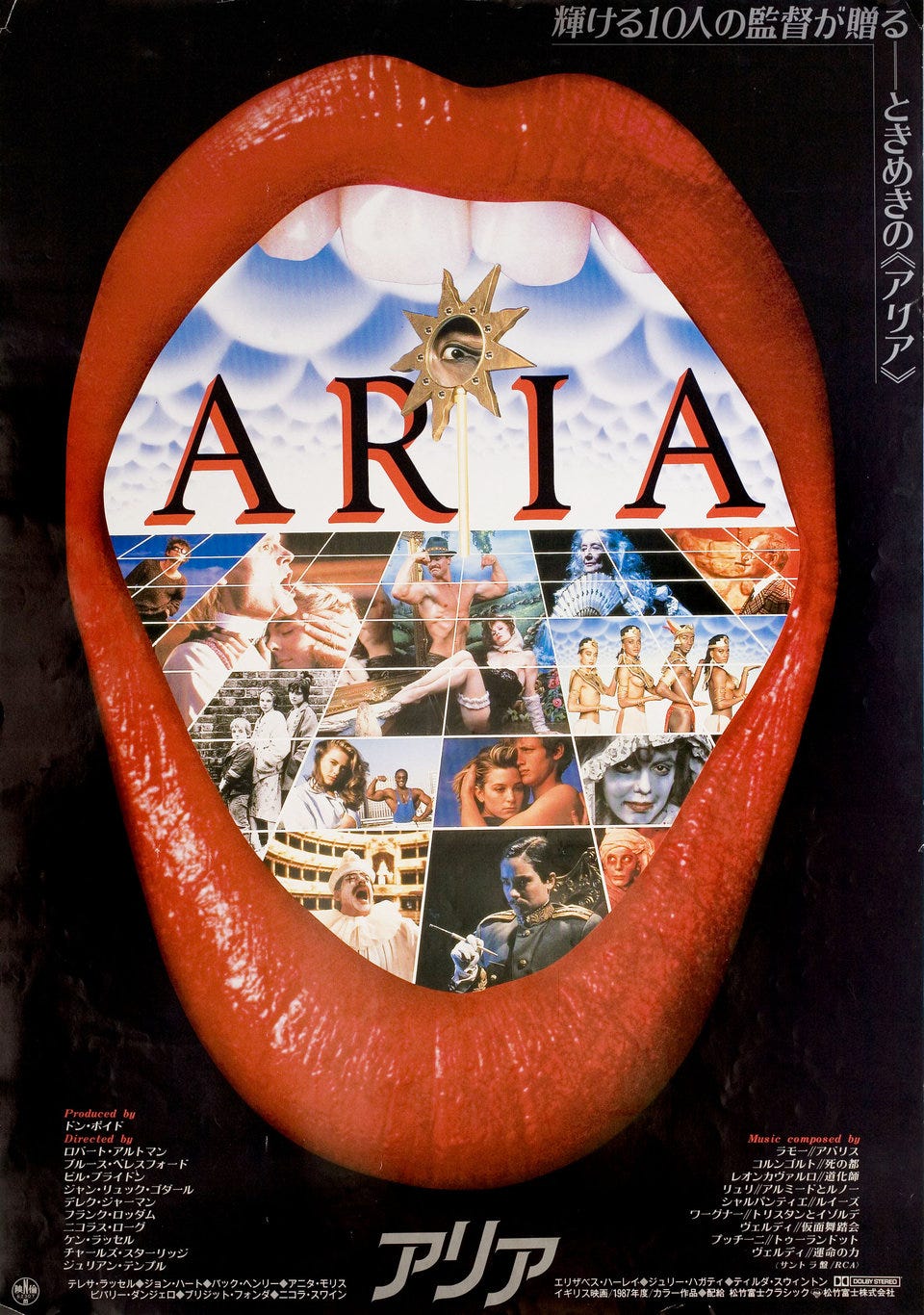
Indeed, Aria producer Don Boyd5 cited Fantasia as a personal favorite and a reference point for this film in a 2024 episode of the Edinburgh Film Podcast. Financed by Columbia/RCA and Richard Branson’s Virgin Group, Boyd invited ten directors to create short films inspired by classic RCA opera aria recordings.
Or, as the English-language poster puts it, “TEN GREAT DIRECTORS. ONE UNFORGETTABLE FILM. THE MOST SENSUAL EXPERIENCE YOU’LL HAVE IN A MOVIE THEATER.” In alphabetical order, the ten directors are:
Robert Altman
Bruce Beresford
Bill Bryden
Derek Jarman
Jean-Luc Godard
Franc Roddam6
Nicolas Roeg
Ken Russell
Charles Sturridge
Julien Temple
Boyd also approached Federic Fellini, who expressed interest but had to pull out due to illness, and Orson Welles, who expressed interest but then died. Altman is actually mentioned by name in one segment, Julien Temple’s take on arias from Giuseppe Verdi’s Rigoletto; Buck Henry plays a philandering Hollywood executive who, in a metafictional moment, calls an actress’s agent and tries to sell the idea of a movie called Aria with segments directed by Altman and Fellini.
The film as a whole is something of a mixed bag. Contemporary critics such as Roger Ebert and Martin Bernheimer compared it to MTV and Aria indeed feels more like ten different music videos than one cohesive film. When I think of the great anthology films — which, to my mind, are Fantasia and Kwaidan (1964) at the very top, with Le Plaisir (1952), Creepshow (1982), a couple of Jim Jarmusch movies and A Touch of Sin (2013) in the next tier — I think of films from a single creative team with some kind of cohesive style and/or creative vision that ties all the segments together.
Besides perhaps the classic British horror anthology Dead of Night (1945), I really can’t think of a live-action, multi-director anthology film that we really remember as a classic film rather than an interesting diversion in a given director’s filmography. If you can think of one, let me know in the comments; it seems like a format that generally leads to a certain inconsistency.
Aria was not a commercial success in 1987, despite some positive reviews and the privilege of closing Cannes. In the aforementioned podcast, Boyd mentions that it was apparently an influence on Baz Luhrmann and especially Romeo + Juliet (1996), which I can definitely see. I’m not going to cover the non-Altman segments, but I’d call Aria an interesting curiosity of a film.
Unlike most Aria directors, Robert Altman had previously directed an opera. As an extension of his theater work, he helmed Igor Stravinsky’s The Rake’s Progress at the University of Michigan’s Power Center for the Performing Arts in 1982.
Stravinsky’s opera7 is an adaptation of William Hogarth’s A Rake’s Progress (1732-1735), a series of eight paintings — later engravings — that tell the story of the prodigal Tom Rakewell, who inherits a fortune, spends it all on luxuries and gambling, and ends up in Bedlam.8 Altman brought a Hogarthian influence to his segment for Aria, which uses arias from Jean-Philippe Rameau’s 18th century opera Les Boréades.
In a fairly scathing review of the entire film, the late Los Angeles Times classical music critic Martin Bernheimer writes that “Robert Altman uses an elegant, archaic extract from Rameau’s ‘Les Boreades’ as an excuse for clumsy Hogarthian pictorialism replete with hints of the Marquis de Sade.” I’m not sure I’d necessarily call it clumsy, but “Hogarthian pictorialism” is an apt description for Altman’s contribution to Aria.
The short film takes place during an 18th century performance of Rameau’s opera, but we never see the singers or the stage. Instead, the camera looks out, as if from the performers’ perspective, at an unruly, bawdy crowd in rags, rouge, face paint and the occasional powdered wig. Some critics describe this scene as a performance for the inmates of an insane asylum, while others describe it as the opera’s opening night for an audience of Parisian lowlifes, Bohemians and slumming aristocrats.
Either way, this seven-minute short film is both Hogarthian and Altman at his most overtly Altmanesque since Popeye (1980). It has no protagonist; the camera roams around the entire jostling, chaotic crowd, who flirt, laugh, dance, fan themselves with fans and fall under the spell of the music before bursting into applause at the end.
Considered alognside The Rake’s Progress, it’s a sequence that, à la Borges’s “Kafka and His Precursors,” suggests Hogarth and Altman as two artists on similar wavelengths despite being separated by more than two centuries. Because Hogarth’s narrative paintings and engravings — crowded, satirical, bustling, occasionally risqué — are also, as Criterion describes Altman’s films, “worlds unto themselves, teeming with more humanity than a single story can contain.” If you brought Hogarth to the 20th century with a time machine, trained him as a filmmaker and gave him a budget, I think his movies would be more than a bit like Nashville or The Player (1992).
Television and the end of the eighties
After a string of theatrical flops, Robert Altman spent the late eighties as an opera and television director, helming another production of The Rake’s Progress at Lille’s Opéra du Nord, two television adaptations of Harold Pinter plays, and a television movie adaptation of Herman Wouk’s The Caine Mutiny Court-Martial starring Eric Bogosian, Jeff Daniels and Brad Davis.
In 1988, he collaborated with Doonesbury cartoonist Garry Trudeau on the HBO miniseries Tanner ’88, a satirical mockumentary miniseries starring frequent Altman collaborator Michael Murphy as an aspiring presidential candidate. “The primary joke of Tanner ’88,” Michael Wilmington writes in a Criterion Collection essay, “is that a completely fictional character could fit in so easily with actual people that they ended up clamoring to share his space: Ralph Nader, Art Buchwald, Studs Terkel, and Gloria Steinem all agreed to serve in Tanner’s cabinet.”
A cult hit that influenced shows like The West Wing, Tanner ’88 earned Altman a Primetime Emmy and helped set the stage for his 1990s comeback, as did a personal lifestyle change. In a 1992 Rolling Stone interview, Altman describes himself as having been a heavy drinker for his entire adult life.
When did you stop drinking heavily?
About three years ago, heavily. And it’s been about a year and a half that I haven’t had any alcohol at all.
Doctor’s orders?
Yeah, it’s my heart. My heart is enlarged. So I just stopped. I still smoke grass when I can. That’s medically advisable.
Now California sober, to use a 2020s-ism, Altman was ready to take on a new decade and new challenges, which I will cover in the next phase of this series.
This film is not on the Criterion Channel. If you want to watch it for some reason (I’d advise against it unless you’re a 100% Altman completist), it’s on Plex.
His first leading role in an Altman movie after bit parts in California Split (1974) and Nashville (1975).
This film is not on the Criterion Channel. You can watch it on Tubi, Plex, or Pluto TV.
The first paragraph of the BFI Screenonline entry on Boyd: “Described by Alexander Walker as ‘a one-man film industry,’ Don Boyd has significantly influenced the face of British film since his first feature in the mid-1970s. Moving from his initial role of director; his ‘art form’, Boyd successfully built his own production company; a bastion for young British talent during the arid climate of ‘70s British cinema. With a prolific production resumé during the late ‘70s and ‘80s, the ‘90s saw a return to directorial work in film as well as some surprising television projects.”
Who you might know as the director of Quadrophenia (1979), the film adaptation of The Who’s rock opera.
With a libretto written by W.H. Auden and Chester Kallman.
I’ve had the joy of seeing Hogarth’s original paintings at Sir John Soane’s Museum in London.