
Altmanesque 11
Vincent & Theo

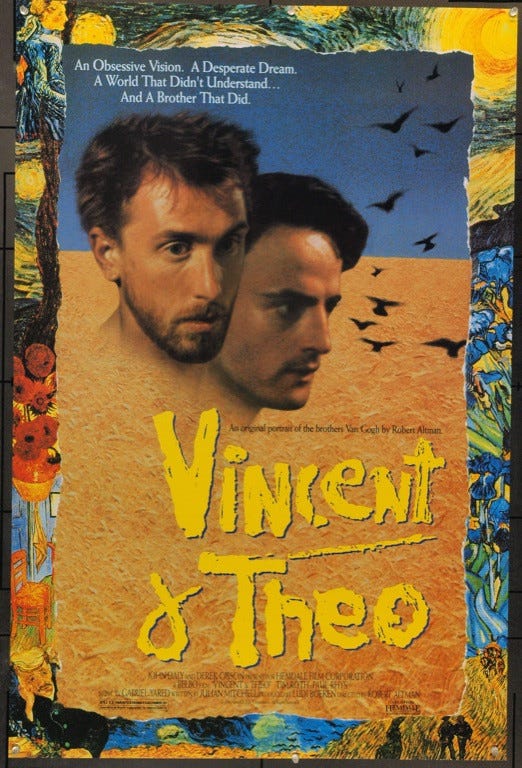
What am I in the eyes of most people? A nonentity or an oddity or a disagreeable person — someone who has and will have no position in society, in short a little lower than the lowest.
Very well — assuming that everything is indeed like that, then through my work I’d like to show what there is in the heart of such an oddity, such a nobody.
This is my ambition, which is based less on resentment than on love in spite of everything, based more on a feeling of serenity than on passion.
Even though I’m often in a mess, inside me there’s still a calm, pure harmony and music. In the poorest little house, in the filthiest corner, I see paintings or drawings. And my mind turns in that direction as if with an irresistible urge.
Vincent van Gogh, July 1882 letter to his brother Theo
The series so far:
Introduction, Countdown, and That Cold Day in the Park
McCabe & Mrs. Miller and Images
The Long Goodbye and California Split
Nashville and Buffalo Bill and the Indians, or Sitting Bull’s History Lesson
Come Back to the Five and Dime, Jimmy Dean, Jimmy Dean and Streamers
Secret Honor and Fool for Love
Robert Altman on the Criterion Channel
Vincent & Theo (1990)1
One of the joys of a retrospective like this is discovering hidden gems, the kinds of films found, if at all, by completionists. You don’t need me to tell you that Nashville (1975) is a classic film worth watching; it received a combined 16 Oscar and Golden Globe nominations, is included in the Library of Congress’s National Film Registry, and regularly appears on all-time greatest films lists. Nashville is one of Altman’s greatest hits, to use a music metaphor, but Vincent & Theo is one of the best deep cuts in his filmography and represents both the true beginning of his nineties comeback and a worthy entry into the canon of films about van Gogh.
If you’ve ever read Vincent van Gogh’s letters, you know that the popular perception of him as the quintessential isolated tortured genius isn’t entirely accurate. My Penguin paperback of his letters to his brother Theo is 560 pages — Vincent was in constant contact with his younger brother, writing him hundreds of letters about his struggles, enthusiasms and epiphanies. And, while most of them have been lost, Theo sent hundreds of letters the other way, along with the monthly payments that funded Vincent’s artistic career. The two brothers grew up together, shared a Montmartre apartment as young ambitious Dutchmen in Paris, and currently lie next to each other in a cemetery in Auvers-sur-Oise. As the title suggests, Vincent & Theo is a film about that brotherhood.
Vincent & Theo began with Dutch producer Ludi Boeken, who initially planned it as a four-hour miniseries to be broadcast on various European television stations for the 100th anniversary of Vincent van Gogh’s death in 1890. Boeken hired Julian Mitchell to write the script and then asked Robert Altman — fresh off the success of the Emmy-winning HBO miniseries Tanner ’88 — to helm the British-Dutch-French-Italian-German coproduction. Altman agreed in exchange for the right to release a shortened version as a theatrical feature film.2
He then traveled to London to audition British actors for the title roles, landing on Tim Roth as Vincent and Paul Rhys as Theo. “At first I was worried about Tim’s strong accent,” Altman later recalled, “but he was so powerful I was convinced.”3 Altman and Boeken surrounded their two leads with a cast of French and Dutch character actors, most notably Jean-Pierre Cassel as Dr. Gachet and Wladimir Jordanoff as a likeable Paul Gauguin.
Behind the camera, Altman brought in a handful of his regular collaborators, including French Canadian cinematographer Jean Lépine, costume designer Scott Bushnell, and his son Stephen, a production designer that Noel Murray aptly describes as an “unsung hero” in his review of the film.
After working as an assistant property master on his father’s late seventies films, the young Stephen Altman learned the art of production design in the trenches. He spent almost a year of his life on the island of Malta as part of the team that built and decorated Popeye Village, one of the most elaborate sets in film history.4 He became a production designer and continued working with his father during the 1980s, transforming a University of Michigan dorm into Richard Nixon’s study for Secret Honor (1984), building a weathered southwest motel for Fool for Love (1985) and generally creating believable sets on low budgets.
Vincent & Theo — which benefits from Altman’s largest budget since Popeye (1980) — represents some of Stephen Altman’s best work. From Vincent’s low-rent Dutch apartments and studios to Theo’s elegant Parisian art dealerships to Vincent and Paul Gauguin’s cluttered Provençal bachelor apartment/studio, he creates a series of convincing, visually compelling environments for the two brothers. These sets, combined with effective location work, give the film a spaciousness and splendor missing from Altman’s low-budget eighties films.
“My view,” Robert Altman tells David Thomson in Altman on Altman, “was that the film was more about a desperate person who felt they had failed than a great artist.”5 Altman emphasizes this gap between van Gogh’s relatively short, turbulent life and posthumous fame with the film’s opening, with a directorial flourish that echoes the multitrack recording and overlapping dialogue of his classic seventies films.
Vincent & Theo begins with archival footage of Vase with Fifteen Sunflowers at a Christie’s auction. The image cuts to more than a century earlier but the sound continues; we see and hear Vincent and Theo arguing about life and money in Vincent’s squalid apartment as the price keeps rising, 500,000 pounds by 500,000 pounds, to the highest stratosphere of international art sales.6
It’s a bold opening that announces a new approach to Vincent van Gogh, one that stresses the sheer incommensurability between his life experiences and his current iconic cultural status.
This opening also sets up the film’s central contrast between Vincent’s Bohemian life as a starving artist and Theo’s career in the respectable bourgeois world of Parisian art dealerships. The first half of the film constantly cuts back and forth between their lives, comparing and contrasting, using juxtaposition to show both brothers as alienated outsiders in their worlds. Vincent the dreamer chasing inspiration and Theo the art lover making a meagre living by selling paintings he hates; Vincent & Theo presents Vincent’s art, made possible by Theo’s financial and emotional support, as the central project of both lives.
When discussing Altman’s eighties films, I tried to highlight at least a memorable scene or two in those generally lesser efforts. I don’t have to do that with Vincent & Theo, because it abounds in memorable moments:
Sunlight streaming through a window and open door into Vincent’s cluttered rural Dutch studio;
Vincent and Sien Hoornik (Jip Wijngaarden) visiting Hendrik Willem Mesdag’s gigantic Hague panorama;
Paul Gauguin combining a cooking lesson with his philosophy of art as he shows Vincent how to make a tomato salad;
Cicadas buzzing as Vincent and Paul Gauguin paint en plein air in the Provencal hillside;
Vincent’s almost hallucinogenic moment in a Provencal sunflower field where, as Roger Ebert puts it, “Altman’s camera darts restlessly, aggressively, at the flowers, turning them from passive subjects into an alien hostile environment.”
And paint everywhere, from the closeup of impasto brushstrokes under the opening credits to the stacked piles of finished canvases in Vincent van Gogh’s various studios. I’ve seen quite a few artist biopics, but I can’t think of one with this much of an emphasis on paint as a physical, tangible substance. Roth’s Vincent van Gogh dips his fingers into dry ground paint, paints canvases, paints a wall, drinks water mixed with paint, dips bread into paint, paints his own face and almost invariably appears with splotches or stains on his hands, face or clothes. He almost literally eats, sleeps and breathes paint.
Perhaps it was this focus on visual creativity – combined, of course, with a larger budget – that pushed Altman and his collaborators to step up their game and deliver their most visually interesting film since 3 Women (1977). While Vincent & Theo lacks the rich, saturated technicolor of Lust for Life (1956),7 Altman’s blocking, his son’s production design, Jean Lépine’s elegant compositions (and occasional, effective use of natural light) and the use of real Dutch and Provencal locations combine into a painterly period piece. Altman uses his trademark slow zooms to visually isolate Roth’s Vincent van Gogh from his surroundings, wordlessly communicating his inability (or perhaps unwillingness) to fit into any social setting.
That is Roth’s van Gogh: a very different character than Kirk Douglas’s heroic, suffering artist in Lust for Life. His Vincent is scuzzy, awkward and clearly neurodivergent, prone to angry outbursts but also capable of affection and camaraderie. Paul Rhys is (invariably) less interesting as Theo but still effective as a character stretched thin by his eventually fatal health problems combined with the simultaneous demands of his marriage, career, newborn child and endlessly difficult older brother. “My feeling was that Theo was the madder of the two,” Altman told Monthly Film Bulletin in 1990. “He was desperately trying to stay in control and conform, although the rebelliousness kept breaking through.”
Vincent & Theo screened at the Toronto International Film Festival as well as Sundance and made approximately $2.2 million in its North American limited release.8 While not exactly a blockbuster, it was Altman’s highest grossing film since Come Back to the Five and Dime, Jimmy Dean, Jimmy Dean (1982), with that box office gross representing extra profit for a miniseries already sold to multiple television stations.
Robert Altman spent the 1980s in director’s jail because his late seventies Fox films flopped at the box office and Popeye developed a notorious, Heaven’s Gate-lite reputation as an indulgent, out-of-control trainwreck of a production. Vincent & Theo represents the culmination of his eighties work, a demonstration of his ability to turn in film and television projects on time, on budget. And, in this case, with some fantastic performances and a real creative vision.
Critics noticed and gave Altman some of his best reviews in years. “Robert Altman, so erratic in recent years, brings an artist’s eye and suffering spirit to his masterly portrait,” in the words of Rita Kempley; fellow Washington Post critic Desson Howe writes that “Altman reasserts his erstwhile eminence wonderfully” and describes Roth’s performance as unforgettable. In his 3.5 star review, Ebert gives the film a beautiful, truly à propos compliment: “the film is able to see the sunflowers as Altman believed van Gogh saw them.” Altman was back.
Vincent & Theo, then, is both the beginning of Altman’s nineties comeback that led to The Player and Short Cuts and a rich cinematic experience in its own right. After 140 minutes of the brothers’ supportive, exasperating, Yin-Yang and sometimes codependent relationship, the final shot of their headstones side by side becomes perhaps the most touching moment in Altman’s filmography.
Just one film this time, as I have a lot to say about both this film and The Player (1992).
I’ll be reviewing that 140 minute theatrical cut here.
Altman on Altman, edited by David Thompson. I found Roth’s accent slightly distracting at the beginning of the film but that soon wore off and I think letting him perform in his natural accent was the best choice, certainly better than directing him to affect a Dutch accent.
“It was a crazy movie,” in his words. “It was like a judge sentencing you to 11 months on the rock, hard labor.”
Altman on Altman.
It was eventually sold to Japanese businessman Yasuo Goto for about $40 million, setting a new record for the most expensive painting ever sold. It soon lost that title to another van Gogh painting, the Irises currently at the Getty Center.
Possibly the classic, definitive Vincent van Gogh biopic. Directed by Vincente Minnelli, starring Kirk Douglas as Vincent and Anthony Quinn, in an Oscar-winning performance, as Gauguin.
https://www.boxofficemojo.com/title/tt0100873/?ref_=bo_rl_ti
This is exactly why I joined Substack. Not only do I love the concept of an Altman retrospective, but I also really enjoy how thoughtful your writing is about the films. It looks like I have my work cut out for me as I go back and read everything else to catch up.
Add to that the fact that I'm also being recommended one of your posts below this comment box that features a Tommy Wiseau thumbnail!
If there's a Substack that checks all of my boxes, yours is it.
I love how you approach film — those deep dives into directors, pulling in context and history, but still keeping it engaging and alive. It feels really informed without ever losing that sense of genuine curiosity and love for the craft. Such a fantastic read, thank you!