
Altmanesque XII
The Player

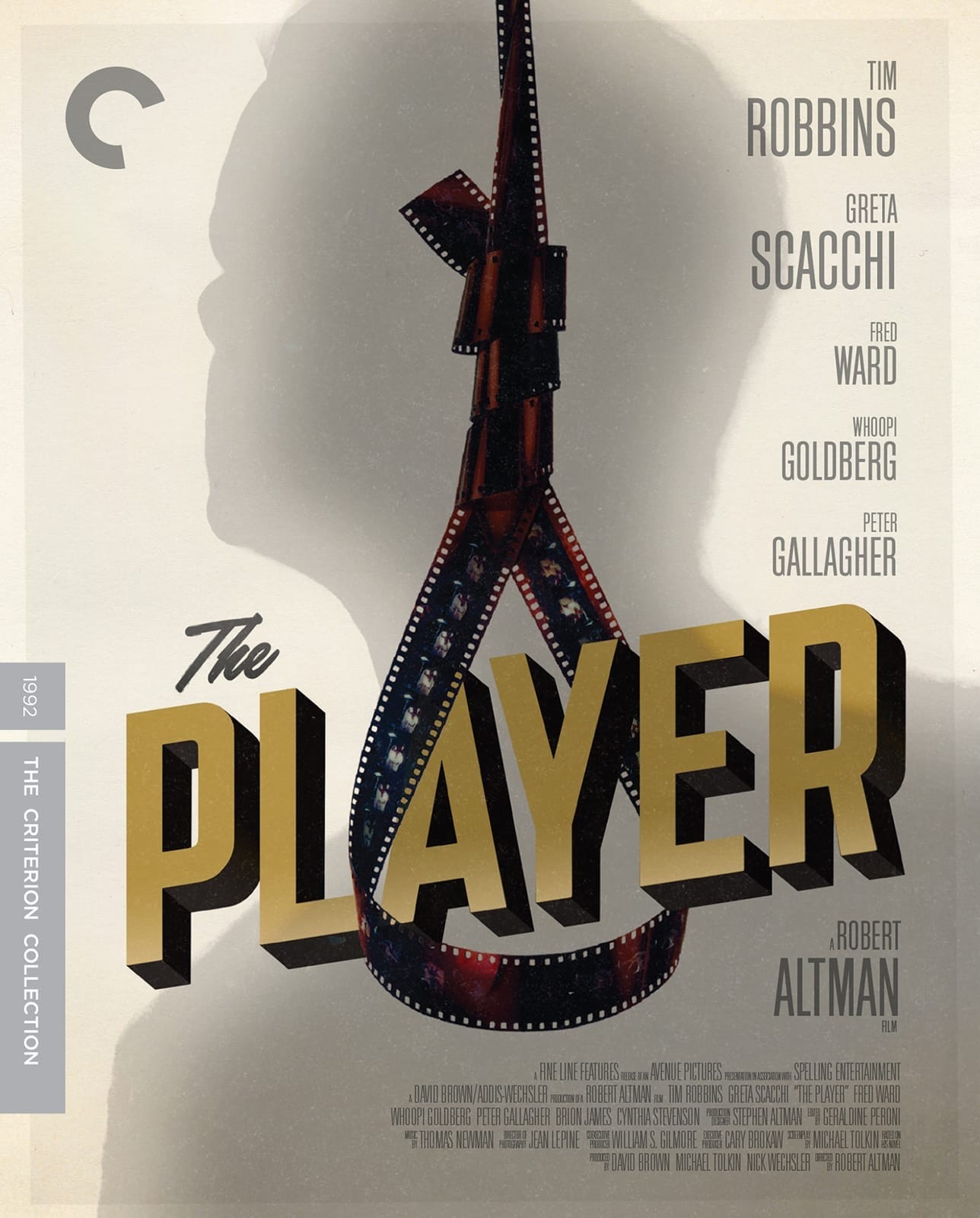
June: Was his story one of the 12?
Griffin Mill: No, it wasn’t.
June: Why?
Griffin Mill: It lacked certain elements that we need to market a film successfully.
June: What elements?
Griffin Mill: Suspense, laughter, violence. Hope, heart, nudity, sex. Happy endings. Mainly happy endings.
dialogue from The Player
The series so far:
Altmanesque I: Introduction, Countdown, and That Cold Day in the Park
Altmanesque II: M*A*S*H and Brewster McCloud
Altmanesque III: McCabe & Mrs. Miller and Images
Altmanesque IV: The Long Goodbye and California Split
Altmanesque V: Nashville and Buffalo Bill and the Indians, or Sitting Bull’s History Lesson
Altmanesque VI: 3 Women and Quintet
Altmanesque VII: A Perfect Couple and Popeye
Altmanesque VIII: Come Back to the Five and Dime, Jimmy Dean, Jimmy Dean and Streamers
Altmanesque IX: Secret Honor and Fool for Love
Altmanesque X: the end of the eighties
Altmanesque XI: Vincent & Theo
Movies, Now More Than Ever! three filmmakers on Robert Altman
Robert Altman on the Criterion Channel
In high school, I took an AP art history class that helped set me on the road that eventually led to Earthly Delights. As a teenager, I was particularly enthralled by a lecture on Diego Velázquez’s haunting, enigmatic, inexhaustible painting about painting, Las Meninas (1656). It still fascinates me and probably laid the groundwork for an appreciation of its distant descendants in a new medium; From Preston Sturges and Billy Wilder to Federico Fellini, François Truffaut, Abbas Kiarostami, Steven Spielberg and many others, the metafictional film about filmmaking has become a regular auteur preoccupation.
Of all these films, The Player (1992) stands out for its sheer self-reflexiveness, the variety of ways in which it emphasizes its own artifice. This is a film that begins with an elaborate, 8 minute-long single take tracking shot that an onscreen character calls out as an homage to Touch of Evil (1958). It includes a parade of celebrity cameos, many of whom are called out by name. It deliberately adopts the styles of different genres at different moments; The Player becomes a voyeuristic psychological thriller when Hollywood studio executive Griffin Mill (Tim Robbins) spies on June Gudmundsdottir (Greta Scacchi) a moody, neon-lit neo-noir when he confronts her boyfriend, disgruntled screenwriter David Kahane (Vincent D’Onofrio). And, of course, it ends with another screenwriter pitching the movie we just saw to Mill. “What do you call this thing?” Mill asks. “The Player” is the response.
“It became a movie about movies,” Altman recalls in Altman on Altman, “and the structure was like a snail that turns in on itself.”1 As a film set in Hollywood, Altman continues, The Player would use
movie plot elements and movie behavior and movie styles and movie music to reflect upon the attitude of people who work in the movies. You see posters and titles everywhere. So it’s all mirrors.
Indeed:
The Player incorporates not one but three films within itself: the very real Bicycle Thieves (1948) alongside two fictional films, The Lonely Room (starring Scott Glenn and Lily Tomlin) and Habeas Corpus (starring Bruce Willis and Julia Roberts).
Characters are constantly surrounded by movie posters that comment – obliquely or directly – on the film’s plot.
Griffin Mill repeatedly asks colleague/on-again, off-again lover Bonnie Sherrow (Cynthia Stevenson) for life advice by framing his predicament as a script he’s working on.
Cinematographer Jean Lépine frequently shoots through windows and other frames-within-frames.
The frustrated screenwriter stalking Mill identifies himself as Joe Gillis, which the film’s characters callout as a reference to the frustrated screenwriter played by William Holden in the quintessential Hollywood noir Sunset Boulevard (1951).
And, as previously mentioned, The Player ends with a pitch for a movie called The Player.
It’s all mirrors.
But this all sounds a bit too highbrow. One of the joys of The Player is that it works as both a metafictional reflection on filmmaking and an entertaining, laugh-out-loud comedy. Hollywood inside baseball references and a running gag about Griffin Mill expressing his essential yuppiedom by ordering many different brands of mineral water. Indeed, it has most of the elements that Griffin Mill identifies as necessary for film marketing: suspense, laughter, violence, nudity, sex, hope of sorts, and of course a happy ending.
A few weeks ago, someone asked me about the best starting point for Robert Altman’s filmography. I think it might be The Player; it was mine.
The Player began with film and television writer Michael Tolkin’s decision to become a novelist. It would have been too obvious, he argues in the film’s audio commentary, for a frustrated Hollywood screenwriter to write a novel about a frustrated Hollywood screenwriter. Instead, he took inspiration from Patricia Highsmith’s Tom Ripley and wrote a darkly comedic thriller about a Hollywood executive who literally gets away with murder.
The 1988 novel The Player attracted the attention of a true Hollywood power player, producer David Brown. I’ve already covered Brown’s most famous film Jaws (1975); his other key credits, generally in partnership with fellow producer Richard D. Zanuck, include The Sting (1973), Steven Spielberg’s theatrical debut The Sugarland Express (1974), The Verdict (1982), Cocoon (1985), A Few Good Men (1992) and Deep Impact (1998).
Robert Altman was offered the director’s chair on the strength of Vincent & Theo (1990). At the time he was working on a passion project, an adaptation of multiple Raymond Carver short stories that became Short Cuts (1993). “But I just couldn’t get the film financed,” he would later recall, and thus agreed to direct The Player. Altman brought much of the planned Short Cuts cast with him, including Robbins, Fred Ward, Peter Gallagher, Lyle Lovett and Buck Henry, who has a scene-stealing cameo as himself.
In addition to the main cast, Altman used his newly regained cachet to enlist a who’s who of Hollywood in cameo appearances. The Player features more Oscar-nominated actors and actresses (24!) than any other film in history because so many Hollywood stars were willing to show up for a day’s shoot, work for scale, poke fun at themselves and their industry, and donate their pay to Motion Picture & Television Fund.2
Michael Tolkin adapted his own novel into the film’s screenplay, which retains the same core plot: the complications arising from Griffin Mill’s attempt to simultaneous deal with threats from an angry rejected screenwriter and maneuver his way into more power at his unnamed Hollywood studio. Some of the film’s best moments are taken directly from the novel, such as Tom Oakley (Richard E. Grant) pitching Habeas Corpus to Griffin Mill. Tolkin’s original story is a skeleton that Altman fleshes out in three main ways.
First, by adding the various metafictional flourishes mentioned above. Second, by shooting on real Hollywood locations and especially by bringing in dozens of Hollywood stars, whose presence paradoxically increases both the film’s sense of deliberate artifice and its verisimilitude.
Third, by playing to one of his great strengths, actorly improvisation. In both the original novel and the film, Griffin Mill attends a studio meeting the day after his fatal encounter with David Kahane. In the novel, Levison (Brion James) has the various studio executives brainstorm reasons why people go to the movies, which he writes down on an easel: ENTERTAINMENT, ESCAPE, SEXUAL PROVOCATION and so forth.
In the film, they decide to workshop what would happen if they cut the middleman — i.e. the writer — from filmmaking. In a quintessentially Altmanesque moment of improvisation, they start pitching movies directly from random newspaper headlines.
‘Mud slide kills in slums of Chile’? That’s good. Triumph over tragedy. Sounds like a John Boorman picture. Slap a happy ending on it, the script will write itself.
Mill, distracted by a newspaper headline that hits close to home, muses about “what an interesting concept it is to eliminate the writer from the artistic process,” a deliciously macabre double entendre.
Listing every funny, memorable moment in The Player would take all day, which is maybe the best compliment I can give it. The epic opening shot alone has multiple moments that stick with me, including Buck Henry, as himself, pitching The Graduate Part 2 and Altman’s seventies protégé Alan Rudolph, as himself, pitching a Bruce Willis vehicle (“not unlike Ghost meets The Manchurian Candidate”) that Mill sums up as “a psychic political thriller comedy with a heart.”
In the 1980s, Robert Altman was Hollywood persona non grata. He got by by teaching university film classes, directing live theater, and making low-budget movies for second-tier studios like Cannon Films and New World Pictures. In the early 1990s, his new movie had enough buzz to spark a distributor bidding war. The winner was New Line Cinema, the house that Freddy built, who distributed it through their new art house division Fine Line Features.
First Line released The Player in March 1992, to coincide with the Oscar season. It then screened in competition at the 45th Cannes Film Festival, with Altman winning Best Director and Robbins winning Best Actor. It was a commercial success, taking in almost $22 million domestic on a budget of $8 million, which represents more than twice the gross of Altman’s previous seven films combined. It was an even bigger hit with critics, whose main talking point becomes apparent in the following headlines:
Player’ Brings Altman Back With a Vengeance (Kenneth Turan, Los Angeles Times)
Altman triumphs with comeback film `Player’ (Malcolm Johnson, Hartford Courant)
Altman returns in his finest form (Hal Lipper, St. Petersburg Times)
‘The Player’ Puts Altman Back in the Game (Peter Bart, San Francisco Chronicle)
“If you knew nothing and cared nothing about the movie business,” the late Gene Siskel writes in his glowing review, “you can still appreciate ‘The Player’ as a ripping good thriller.”3 It represents Altman’s “return to power,” in his words, as well as a return to something quintessentially Altamanesque, the new twist on the old icon:
What ‘M*A*S*H’ did to service comedies, what ‘McCabe and Mrs. Miller’ did to westerns, what ‘The Long Goodbye’ did to detective pictures, ‘The Player’ does to the Hollywood success story.
In a year-end retrospective, Siskel named The Player the second best film of 1992, while his cohost Roger Ebert put it in eighth place. Peter Travers put it in first place in his Rolling Stone “The Year in Movies” retrospective, praising it for capturing “precisely what’s wrong with the people who make movies and the people who watch them.”4
This critical acclaim translated into Altman’s strongest ever awards season recognition:
Golden Globes for Best Motion Picture – Musical or Comedy and Best Actor – Musical or Comedy, with nominations for Best Director and Best Screenplay
The Independent Spirit Award for Best Feature
BAFTAs for Best Direction and Best Adapted Screenplay, with nominations for Best Film, Best Actor in a Leading Role and Best Editing
Nominations for Best Director, Best Adapted Screenplay and Best Editing at the 65th Academy Awards.
Altman received his first Oscar nomination for directing M*A*S*H (1970), a military satire that resonated with the American counterculture during the Vietnam war. Two decades later, he returned to prominence with the perfect film for a cultural zeitgeist experiencing simultaneous alternative rock and indie film booms. A film mocking profit-focused Hollywood executives and Hollywood happy endings was the right film for the right time; The subversive New Hollywood maverick had reestablished himself as a sympatico precursor to a new generation of American filmmakers.
Altman himself, for what it’s worth, pushed back against the idea of The Player as a scathing satire of the American film industry. “I’m still very surprised when people say, ‘Oh my God, you really got Hollywood,” he told David Thomson in Altman on Altman. “Because it’s just a funny conceit, that film, and the truth is much, much worse.”
As always, my primary source for this series is the book-length interview Altman on Altman, edited by David Thompson.
If you count cameos from people with Oscar wins/nominations as writers or producers, the number rises to 28. Winners Cher, James Coburn, Louise Fletcher, Whoopi Goldberg, Joel Grey, Anjelica Huston, Jack Lemmon, Marlee Matlin, Sydney Pollack, Tim Robbins, Julia Roberts, Susan Sarandon, and Rod Steiger; nominees Karen Black, Gary Busey, Peter Falk, Teri Garr, Jeff Goldblum, Elliott Gould, Richard E. Grant, Buck Henry, Sally Kellerman, Sally Kirkland, Nick Nolte, Burt Reynolds, Dean Stockwell, Michael Tolkin and Lily Tomlin.
Siskel, Gene. “Siskel’s Flicks Picks: Altman targets Hollywood in masterful ‘Player’.” Chicago Tribune (1963-1996), 24 Apr., 1992, pp. 1.
Travers, Peter. “The Year in Movies.” Rolling Stone. December 10, 1992
The Player certainly is a great starting point for any would-be Altman connoisseur. I've always been astounded at just how well Altman parses his ensemble casts. Not overly chaotic, they're always strung together to utilize the best of their abilities, always moving the plot forward. Many directors seem to fumble a big-name cast. So much so I stopped seeing most films that touted more than one big star on their bill because it seemed they relied too heavily on that star power and not a strong, engaging plot or craftful maneuvering of said talent. Great essay, once again!