
Altmanesque 15
The Gingerbread Man and Dr. T & the Women

But, you know, it's like your own children. All these films, I love them all. And we tend to love our least successful children the most 'cause they seem to need the most protection. But when they're finished, they're finished and they're disconnected from me. That cord is cut.
Robert Altman, 2000 NPR interview
The series so far:
Introduction, Countdown, and That Cold Day in the Park
McCabe & Mrs. Miller and Images
The Long Goodbye and California Split
Nashville and Buffalo Bill and the Indians, or Sitting Bull’s History Lesson
Come Back to the Five and Dime, Jimmy Dean, Jimmy Dean and Streamers
Secret Honor and Fool for Love
Movies, Now More Than Ever! three filmmakers on Robert Altman
Robert Altman on the Criterion Channel
The Gingerbread Man (1998)
After Kansas City (1996) flopped, a new career opportunity fell into Robert Altman’s lap. Polygram had signed Kenneth Branagh to star in an original John Grisham story, in a deal that gave Branagh choice of director. Altman was on the shortlist and he both needed the work and thought that directing a suspenseful thriller would be an interesting new creative challenge.1
I’ve never read a John Grisham novel, but I know that he was one of the most commercially successful authors of the 90s and 2000s. In his prime, he had an almost Stephen King-level bestselling-novel-to-big-screen pipeline: The Firm and The Pelican Brief in 1993, The Client in 1994, A Time to Kill and The Chamber in 1996. At about the same time as Altman got the offer to direct The Gingerbread Man, fellow New Hollywood veteran Francis Ford Coppola began work on his John Grisham movie, The Rainmaker (1997). In both cases, adapting a hugely successful novelist seemed like the right step towards a career comeback.2
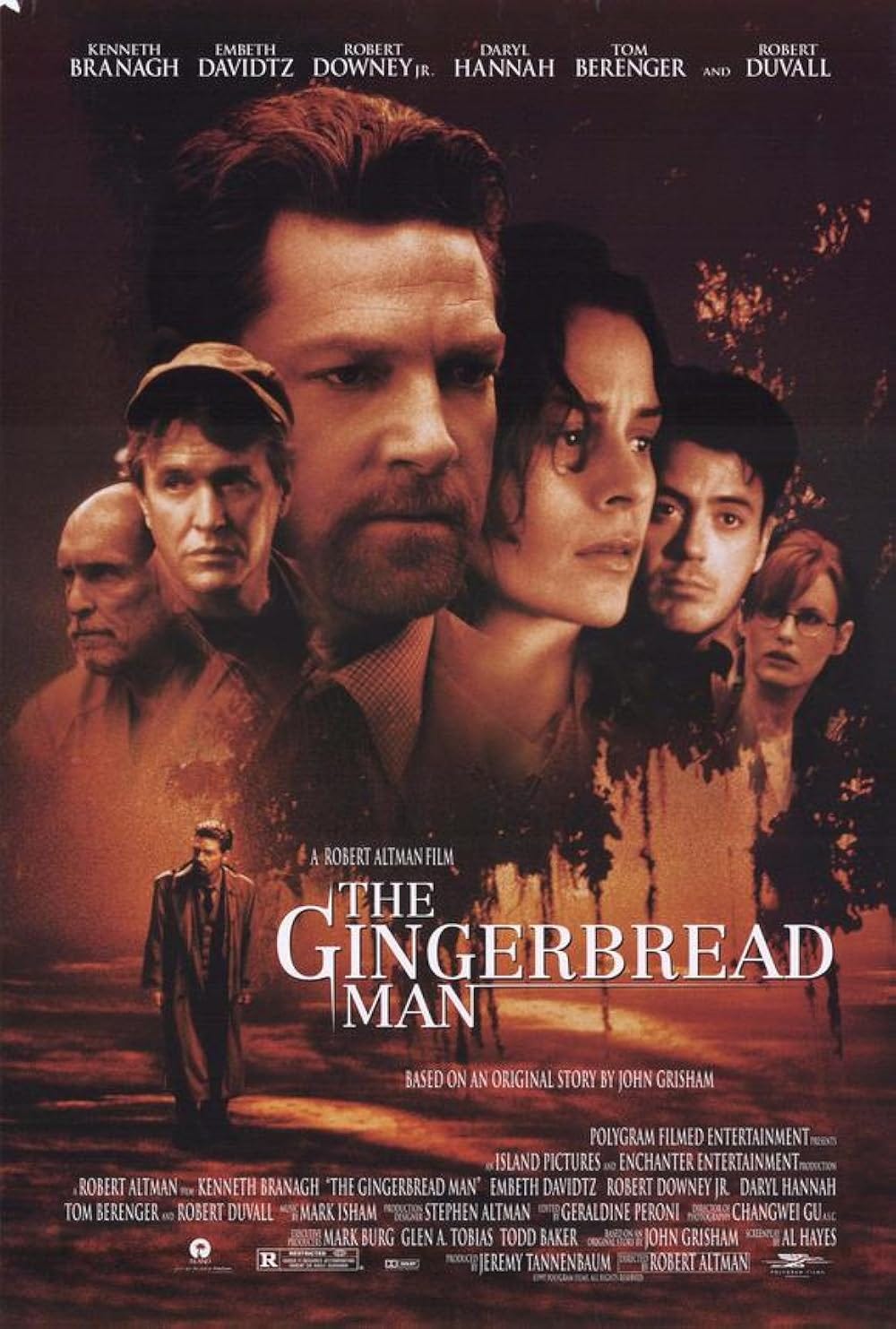
So Altman signed on to direct The Gingerbread Man for Polygram’s Island Pictures subsidiary.3 Before discussing the production, I’d like to discuss that title, which I think is one of the reasons why this film is mostly forgotten.
I haven’t really talked about the titles of Altman’s films in this retrospective because they generally work. M*A*S*H, Nashville, The Player and even Prêt-à-Porter all aptly describe their respective films; Brewster McCloud, McCabe & Mrs. Miller, Popeye, Vincent & Theo are the names of protagonists, and so forth.
As a title, The Gingerbread Man is strongly evocative of things that this movie is not about: childhood, baking, Christmas treats. Altman, Grisham et al do try to justify the title with a sequence where the protagonist’s long-suffering ex-wife (Famke Janssen) tells him the fairy tale about the gingerbread man deceived and devoured by the fox; this serves as an obvious metaphor for their dangerous situation. If the film felt like a macabre twisted fairy tale, then the title might work, but The Gingerbread Man on a poster or theater marquee just doesn’t communicate noirish John Grisham thriller.4 Grisham novels and their movie adaptations generally have much more straightforward titles: The Firm, The Client, The Chamber.
But, as we’ll see, there’s a much bigger reason why this film didn’t reach a wide audience.
Robert Altman made three key creative decisions for The Gingerbread Man.
First, he changed Grisham’s heroic lawyer into a flawed antihero; Rick Magruder (Branagh) is an impulsive philanderer who neglects his family. In a Hitchcockian move, his weaknesses make him the perfect target for the film’s overarching conspiracy, the perfect tool to accomplish their plot. He does have good qualities, as both a successful lawyer and a father very serious about his children’s safety, and this combination of virtues and vices makes him a compelling protagonist.
Second, Altman set and shot the film in Savannah, Georgia, one of the oldest cities in the United States: the capital of the British Province of Georgia, the endpoint of Sherman’s March to the Sea, the hometown of Flannery O’Connor. In the 21st century, Georgia became the ‘Hollywood of the South’ and Savannah became a regular filming location. In the 90s, on the other hand, The Gingerbread Man and then Clint Eastwood’s Midnight in the Garden of Good and Evil (1997) were some of the first major films shot there. The Gingerbread Man benefits greatly from its atmospheric setting, from historic buildings and rain dripping from the branches of live oaks covered in Spanish moss. Altman also set the film during the buildup to a (fictional) hurricane, which gives it a perfect cloudy, rainswept, almost Southern Gothic gloom for a thriller/neo-noir.
Finally, Altman brought on a new creative collaborator, Chinese cinematographer Gu Changwei. Gu was a major figure in the Fifth Generation of Chinese cinema, collaborating with directors Zhang Yimou and Chen Kaige and earning an Oscar nomination for his work on Farewell My Concubine (1993). Altman saw that film and thought that Gu could bring a new visual style to The Gingerbread Man, which he does: via aerial photography, crane shots, a handful of handheld shots and the darkest palette in Altman’s filmography.
The Gingerbread Man looks different than any other Altman movie and its visual uniqueness begins with its opening sequence, a seemingly endless aerial shot with the camera flying over flood plains, snaking rivers and deltas with few visible signs of human civilization. It feels like something you’d see in a Werner Herzog documentary and begins the film on a strangely beautiful, strangely ominous note.
You’d have to return to Altman’s two sixties films that I covered at the beginning of this series to find a less Altmanesque Robert Altman film. The Gingerbread Man lacks pretty much all of his trademarks, except perhaps for a focus on flawed characters and a strong sense of place. Instead, it’s a pulpy nineties thriller with a big plot twist. It offers nothing particularly new, but I found it a pleasant surprise: a well-executed, atmospheric example of its genre.
The cast is a big reason why. I generally like Kenneth Branagh as an actor, at least when he’s not playing Hercule Poirot, and he does not disappoint here. A northern Irishman, he nails a southern accent and gives Magruder a very different speech pattern than any other character I’ve seen him play. Janssen (Dutch) and Embeth Davidtz (American/South African) do surprisingly well, accent-wise, as does Robert Downey, Jr. in his first role after his first drug-related arrest.5 And the late Robert Duvall was and is a Hollywood icon and brings a creepy gravitas to his backwoods patriarch.
The Gingerbread Man also has a good hook. Branagh’s Magruder has an affair with Davidtz’s Mallory and decides to protect her from her violent, unstable father (Duvall), a decision that entangles him in a web of deceit, arson and murder. It’s an elevator pitch that Griffin Mill could appreciate it. If things unfolded differently, The Gingerbread Man could have been Altman’s commercial comeback, a sign of his versatility as a filmmaker.
However, the film’s postproduction turned into a debacle. After Altman’s final cut underperformed with test audiences, Polygram hired a new editor to recut the film, which caused Altman to ask the Directors Guild of America to take his name off of The Gingerbread Man. Island Pictures CEO Chris Blackwell6 resigned to protest Polygram’s decision, setting off events that led Polygram to close Island at the end of 1997.
Looking to avoid more negative PR, Polygram buried The Gingerbread Man, giving it a minimal theatrical release in the ‘dumping month’ of January; their other late January release, the Spice Girls vehicle Spice World, clearly got the lion’s share of the marketing budget. Ironically, their recut tested even worse than Altman’s original cut, so it’s his version that got a very limited theatrical release (and is currently available on Amazon Prime.)
Dr. T & the Women (2000)
After the Polygram debacle, Altman returned to television, producing a short-lived ABC anthology series called Gun which is remembered, if at all, as the late James Gandolfini’s first television show. Altman directed one of the series’ six episodes, which was written by script supervisor-turned screenwriter Anne Rapp, who became a key creative collaborator.
Altman directed Rapp’s first feature screenplay, Cookie’s Fortune (1999), which premiered at Sundance, received three Independent Spirit Awards, and earned Altman his best reviews since Short Cuts (1993).7
Altman and Rapp began work on More Short Cuts but realized it would be an unnecessary sequel and abandoned the project. Instead, Altman expressed interest in one of Rapp’s story treatments about a Dallas gynecologist. She expanded the story into a feature-length screenplay, which Altman sent to Richard Gere.
“There were no big money discussions,” Altman would later recall, and the presence of a bankable star attracted the attention of both a production company (British producer Graham King’s Initial Entertainment Group) and a distributor (Artisan Entertainment, fresh off the out-of-the-blue success of The Blair Witch Project.)8 In Altman’s words, “once I had Gere, I had no particular problems.”
With funding secured, Altman and co surrounded Gere with a multi-generational galaxy of star actresses: Helen Hunt, Laura Dern, Farrah Fawcet, Kate Hudson, Liv Tyler. They shot on location in Dallas, making Dr. T & the Women Altman’s third Texan film after Brewster McCloud (1970) and Come Back to the Five and Dime, Jimmy Dean, Jimmy Dean (1982).
Unlike The Gingerbread Man, Dr. T & the Women has a title that makes sense in context: Gere plays gynecologist Dr. Sullivan Travis, or Dr. T for short, who is surrounded by women in his personal and professional lives. Both his clients and family are upper-class women, targets of a satire that many critics objected to. Guardian critic Peter Bradshaw, for instance, called it “silly, supercilious, casually misogynist nonsense;”9 Jonathan Rosenbaum described himself as “uncomfortable with the blatant misogyny at its center.”
That center is the film’s inciting incident: Dr. T’s wife Kate Travis (Fawcett) develops a (fictional) psychological condition called a ‘Hestia complex,’ a disorder where overly privileged, pampered women regress to a childlike state. The loose plot follows Dr. T coping with her absence, which includes an affair with professional golfer Helen Hunt, dealing with recently divorced sister-in-law Laura Dern, and trying to be a good father to his daughters Kate Hudson and Tara Reid.
The defenses offered by Altman and his supporters are a) that the film was written by a woman and b) that its satire is aimed at a very specific target, e.g. the kind of person who would later star in one of the many Real Housewives spinoffs. In a 2000 Salon interview, Rapp herself defended the Hestia complex plot point as a parody of then-current discourse about women’s emotions in self-help books and on daytime tv.
My two cents? It doesn’t work as satire because it’s neither funny nor thought-provoking. It’s a glaring dissonant note in what’s otherwise a quirky, laidback, amiable dramedy, a movie that I could otherwise see as someone’s comfort watch. Besides that misstep, the most memorable aspect of Dr. T & the Women is its ending, which is both completely out of left field and surprisingly, weirdly satisfying. A Wizard of Oz homage that’s one of the strangest onscreen moments in a gloriously strange career.
As always, my primary source for this series is the book-length interview Altman on Altman, edited by David Thompson.
Both movies underperformed at the box office, Altman’s for reasons I’ll get into a bit later.
A spinoff of Chris Blackwell’s Jamaican-British record label Island Records.
Perhaps Grisham was thinking of another massively popular 90s crime author, James Patterson, whose Alex Cross novels had fairy tale titles and nursery rhyme titles.
His private investor drinking in bars and, at one point, telling Branagh that he’s feeling “a little toasted” is art imitating life to a somewhat uncomfortable extent.
Blackwell is best known as a Rock and Roll Hall of Fame-inducted music producer and executive whose Island Records brought reggae music to a global audience. He also has a cinematic legacy; he funded The Harder They Come (1972), the very first Jamaican feature film, and founded Island Pictures, which distributed films like Down by Law (1986) and Spike Lee’s debut She’s Gotta Have It (1986).
It’s not on any streaming service in the US, so I won’t be covering it here.
Later GK Films. While not necessarily a household name, King became an Oscar-winning Hollywood power player in the 21st century: co-producing Martin Scorsese movies like The Aviator (2004) and The Departed (2006) and big biopics like Bohemian Rhapsody (2018) and Michael (2026). His GK Films produced another Best Picture winner, Argo (2012), as well as latter-day films from Clint Eastwood and Tim Burton.
He also joked that he would have rather seen a movie called Mr. T & the Women, which is a fantastic diss.
I like reading about these "less successful children"! Yes, a title carries a lot of weight. And LOL, I really would have liked to see what Mr. T would do surrounded by overbearing women.