
Altmanesque XIII
Short Cuts

I want to spend the day watching this happen
and reach my own conclusions.
I hate to seem greedy—I have so much
to be thankful for already.
But I want to get up early one more morning, at least.
And go to my place with some coffee and wait.
Just wait, to see what’s going to happen.
From the poem “At Least” by Raymond Carver
The series so far:
Altmanesque I: Introduction, Countdown, and That Cold Day in the Park
Altmanesque II: M*A*S*H and Brewster McCloud
Altmanesque III: McCabe & Mrs. Miller and Images
Altmanesque IV: The Long Goodbye and California Split
Altmanesque V: Nashville and Buffalo Bill and the Indians, or Sitting Bull’s History Lesson
Altmanesque VI: 3 Women and Quintet
Altmanesque VII: A Perfect Couple and Popeye
Altmanesque VIII: Come Back to the Five and Dime, Jimmy Dean, Jimmy Dean and Streamers
Altmanesque IX: Secret Honor and Fool for Love
Altmanesque X: the end of the eighties
Altmanesque XI: Vincent & Theo
Altmanesque XII: The Player
Movies, Now More Than Ever! three filmmakers on Robert Altman
Robert Altman on the Criterion Channel
“The work of two great American artists merges in Short Cuts,” to quote the Criterion Collection blurb, which describes the film as “a kaleidoscopic adaptation of the stories of renowned author Raymond Carver by maverick director Robert Altman.”
Altman discovered Carver’s work shortly after his untimely death in 1988 and had a creative epiphany while reading a collection of Carver’s short stories on a long-haul flight. “They were terrific because he made stories out of small incidents,” Altman would later tell David Thompson in Altman on Altman.
None of these people were extraordinary, but mundane events could have an important emotional significance. And these stories were so unstructured that no one would automatically say, ‘Oh, let’s make a film out of this.’ But I saw them as a movie right away, using them as a basis, shuffling images and lines, with a piece from one story and a paragraph from another, and I started writing it with Frank Barhydt.1
Carver did have cinematic aspirations, as I learned in Charles Elton’s book Cimino: The Deer Hunter, Heaven’s Gate, and the Price of a Vision. Carver and his eventual wife and eventual widow Tess Gallagher (an award-winning writer in her own right) cowrote two screenplays with Michael Cimino2 in the early 1980s. Cimino’s post-Heaven’s Gate (1980) pariah status meant that both their Fyodor Dostoevsky biopic and Purple Lake — about juvenile delinquents on a road trip across American — joined his long list of unrealized film projects.
Short Cuts, then, represents the true beginning of Carver’s cinematic legacy, which encompasses a small but interesting list of films. The Best Picture winner Birdman (2014) follows a washed-up Hollywood star as he attempts to resurrect his career with a play based on Carver’s short story “What We Talk About When We Talk About Love.”3 In a rare dramatic role, Will Ferrell starred in Everything Must Go (2010), an adaptation of Carver’s story “Why Don’t You Dance” that I haven’t seen in a long time but remember being surprisingly good. Australian filmmaker Andrew Kotatko has directed two award-winning short films based on Carver’s stories, while Jindabyne (2006) adapts “So Much Water So Close to Home” to an Australian setting.
At first glance, the pairing of Carver and Altman might seem like something of a mismatch. Carver is the quintessential postwar American minimalist, an author of sparse short stories and poems who once aptly described himself as “inclined toward brevity and intensity.”4 Altman is a cinematic maximalist, a filmmaker whose name has become an adjective to describe sprawling films, abounding in local color and narrative detail, that follow the intersecting lives of a large cast of characters.
And Short Cuts is not a strictly faithful adaptation. Altman and Barhydt blend elements of nine stories and one prose poem,5 renaming and combining characters, inventing a few new characters and plot points, and moving the setting from Carver’s Pacific Northwest to nineties Los Angeles. Carver’s brief, stripped-down short stories are the foundation for a 188-minute-long panorama across two dozen interconnected characters.
On the other hand, Altman and Carver are sympatico in some important ways. They are both, as Criterion suggests, quintessentially American artists, with a somewhat Whitmanesque sensibility, an interest in everyday American people. Robert Altman does have a few 3-hour movies on his resume, but he’s no David Lean; he rarely if ever tells the tale of a hero on an epic journey. He makes war movies with zero onscreen combat and a movie about the rise and fall of a US president without any typical biopic tropes.
Instead, as I hope I’ve shown throughout this series, some of the best moments in Altman film — even the long, ambitious ones — are the small moments. The aggregate effect of little details that makes the onscreen military hospital or frontier town or Hollywood studio feel like a real, lived-in place, like a community with its own history and hierarchies. That’s what Carver does in his best stories: expressing the history of marriage or a family or a friendship in a few well-chosen details.
And, while Altman and Barhydt change the setting of Carver’s stories, they retain much of their social and psychological landscapes. “The Player deals with upper-level LA, the world of the studios, stars, and executive deals,” Michael Wilmington writes in his Criterion Collection essay. “Short Cuts focuses on the middle-class world that surrounds them: the sunny, smoggy subdivisions.”
While there are a few upper-middle class characters in Short Cuts (Bruce Davidson’s tv news anchor, a doctor-painter married couple played by Matthew Modine and Julianne Moore), it primarily focuses on white working-class characters. On waitresses, chauffeurs, children’s party entertainers, bakers, pool cleaners, phone sex operators. They drink beer, eat at diners, go on fishing trips, argue with their spouses, talk on the phone (there are well over a dozen phone conversations in Short Cuts), watch television and do other quotidian activities; Short Cuts is faithful to the spirit, if not the letter, of Carver’s dirty realism.
Altman’s two previous films led directly to Short Cuts; seeing Vincent & Theo (1990) convinced Tess Gallagher that Altman was the right filmmaker to adapt Carver and the critical and commercial success of The Player (1992) got the ambitious project funded. Spelling Entertainment/Spelling Films International and Avenue Pictures, the production companies that made The Player, returned for Short Cuts, with Avenue Pictures executive Carey Brokaw serving as the film’s producer and First Line Features again distributing.
Behind the camera, many of Altman’s regular collaborators also returned, including his son, production designer Stephen Altman, Oscar-nominated editor Geraldine Peroni and executive producer Scott Bushnell. Instead of regulars Pierre Mignot or Jean Lépine, Altman brought on cinematographer Walt Lloyd, who had shot Steven Soderbergh’s first two films.
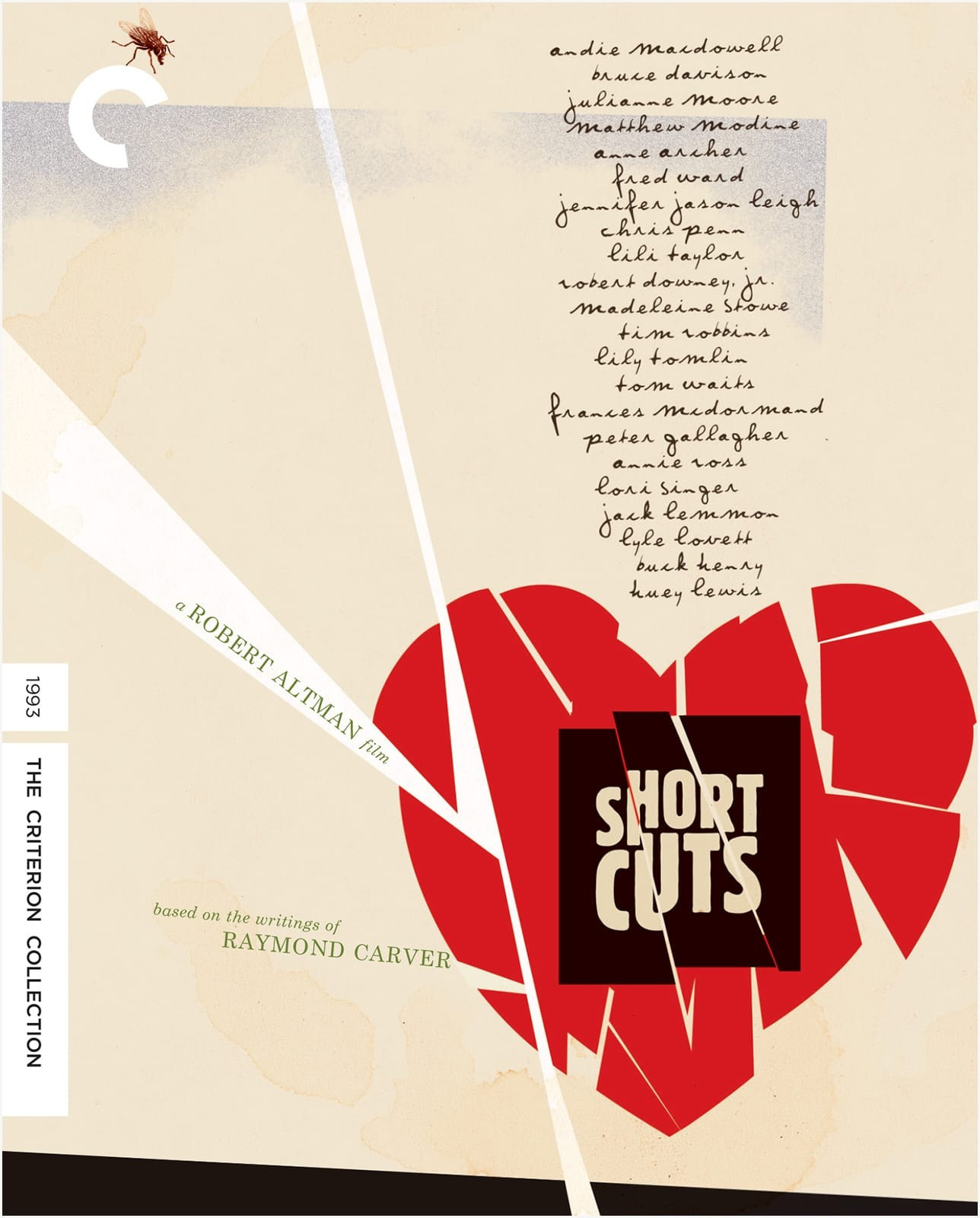
In front of the camera was the star-studded list of actors on the Criterion Blu-ray cover. In Altman on Altman, David Thompson asks Altman how he managed to assemble such a star-studded cast on a relatively low budget. “That was actually kind of easy to do,” Altman responds,
Because nobody worked more than eight days and they all worked for the same fee. I could say to you, ‘Come and work six days,’ and you’d say, ‘Ok, that’ll be fun, I can do that.’ I used recognizable artists for all the characters so that the audience would remember who they were. And I had a good reputation with actors, so I was able to attract them.
Altman goes on to note that the film’s Los Angeles locations — like those of The Player — made participating much more convenient for actors.
Unlike some previous Altman efforts, the production was highly organized, on schedule and on budget. In a 1993 Film Comment article about the film’s production, Buck Henry describes Altman’s approach to improvisation — “he tries to get it to sound more like life and less like writing, more like behaving and less like acting” — and a generally positive atmosphere on set. In his words, “there is a kind of family spirit in which everybody is having a really good time playing an interesting game.”
The biggest production challenge was a southern California heatwave that pushed temperatures well above 100 degrees, which makes Los Angeles’s desert heat, light and haze almost tangibly present in the final film.
Short Cuts was what TV Tropes called an Acclaimed Flop: rave reviews from critics, the Golden Lion6 and Volpi Cup at the Venice Film Festival, Best Feature/Director/Screenplay at the Independent Spirit Awards but a $6 million box office gross on a $12 million budget.
A 3-hour literary adaptation about ordinary people living lives of quiet desperation is a tough sell, certainly not the kind of film that Griffin Mill would greenlight; Short Cuts is one of those movies that could have only made money with a Best Picture nomination bump at the box office. But that year’s nominees were Schindler’s List, The Fugitive, In the Name of the Father, The Piano and The Remains of the Day,7 with Altman joining a small but distinguished club of filmmakers up for Best Director as their film’s sole nomination.8 None of the ensemble cast received a Best Supporting Actor or Actress nomination, possibly because there were simply too options and voters went with films with just one or two standout supporting performances.9
In April 2026, a month after Paul Thomas Anderson won Oscars for Best Picture, Best Director and Best Adapted Screenplay, the clearest legacy of Short Cuts is its influence on Magnolia (1999); the former seems like the template for the latter.
Both films are just over three hours long. Both are about the gestalt impact of many different characters leading simultaneously isolated and interconnected lives in Los Angeles and, by extension, about the randomness and tragicomedy of contemporary American life. Both involve plot threads about the fraught relationships between parents and adult children; both have a pivotal scene in which a character played by Julianne Moore confesses to cheating on her husband.10 Both end with an act of God that serves as the one unifying, shared experience for their casts of characters.
Paul Thomas Anderson brings a Sturm und Drang to Magnolia that’s completely absent from short cuts: whip pans, Biblical references, an unbroken one-take tracking shot that lasts for more than two minutes,11 a musical-style sequence where different characters in different locations all sing along to Aimee Mann’s “Wise Up,” an ending that more than hints at the supernatural. Call it melodramatic, but if you watch Magnolia at the right moment — as I did in my early twenties — then it can be one of the great, emotional, cathartic cinematic experiences.
Short Cuts is a calmer, quieter film with less obtrusive camerawork. Less operatic (another word frequently used to describe Magnolia) and more grounded. More mundane. In other words, much more like a Raymond Carver story.
Barhydt first met Robert Altman in the 1950s, when his father’s Kansas City-based company hired Altman to direct a series of educational and industrial films. He would reconnect with Altman in the seventies, cowriting Quintet (1979) and acting in the HBO miniseries Tanner ’88.
Considering a Michael Cimino retrospective later this year. If that interests you, please let me know.
Birdman begins with a quote from “Last Fragment,” a poem Carver wrote shortly before his death.
He’s probably an influence on my own short fiction. He’s just part of the DNA of contemporary American literature, the blueprint for writers’ workshop/MFA fiction.
The stories are “Neighbors,” “They’re Not Your Husband,” “Vitamins,” “Will You Please Be Quiet, Please?”, “So Much Water So Close to Home,” “A Small, Good Thing,” “Jerry and Molly and Sam,” “Collectors” and “Tell the Women We’re Going,” plus the prose poem “Lemonade.”
I’m taking a lot of pre-production and production history details from the making-of documentary Luck, Trust & Ketchup: Robert Altman in Carver Country.
Shared with the Krzysztof Kieślowski film Trois couleurs: Bleu (1993).
One factor had to be that the five Best Picture nominees were distributed by major Hollywood players (Universal, Columbia, Warner, Miramax) whereas Short Cuts was distributing by the arthouse subsidiary of a studio still best known for Freddy Krueger and Teenage Mutant Ninja Turtles.
Other members include David Lynch (twice, for Blue Velvet and Mullholland Drive), Federico Fellini (Fellini Satyricon) and Martin Scorsese (The Last Temptation of Christ.)
Despite Altman’s reputation as an actor’s director, his filmography includes just six Oscar-nominated performances, none by men: Sally Kellerman for M*A*S*H, Julie Christie for McCabe & Mrs. Miller, Ronee Blakely and Lily Tomlin for Nashville, Maggie Smith and Helen Mirren for Gosford Park.
In Magnolia she’s acting opposite Robert Altman regular Michael Murphy.
Is this shot — a long take traveling through a television studio — another Altman reference? To The Player, which begins with an even longer single take shot that movies in and out of a movie studio?
This does a great job unpacking why Short Cuts works. Especially the balance between Raymond Carver’s minimalism and Robert Altman’s expansiveness. I like how you frame their overlap in the small, lived-in moments rather than their differences. The comparison to Magnolia also lands well. It clarifies what makes Altman’s approach feel quieter and more grounded without underselling its scope.