
Altmanesque 16
Gosford Park

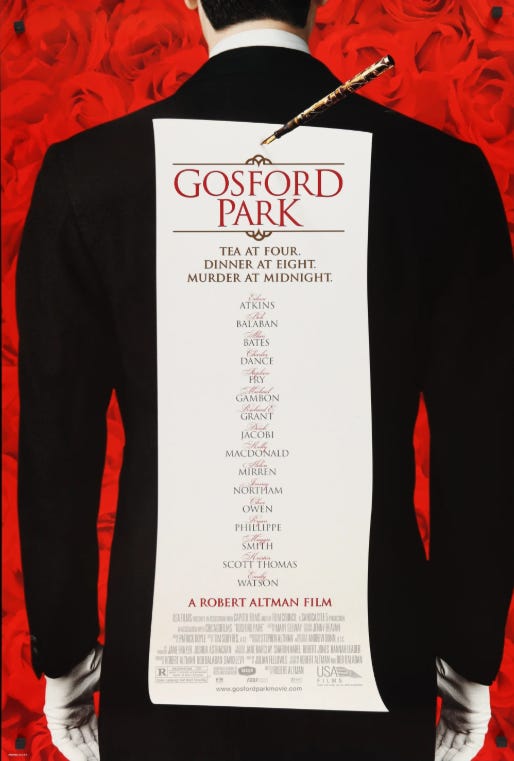
What if Robert Altman had to fill out a form and list his credits? It would look funny. It would probably look fake. How could one person be responsible for so many good films?
Paul Thomas Anderson, foreword to Altman on Altman
The series so far:
Introduction, Countdown, and That Cold Day in the Park
McCabe & Mrs. Miller and Images
The Long Goodbye and California Split
Nashville and Buffalo Bill and the Indians, or Sitting Bull’s History Lesson
Come Back to the Five and Dime, Jimmy Dean, Jimmy Dean and Streamers
Secret Honor and Fool for Love
The Gingerbread Man and Dr. T & the Women
Movies, Now More Than Ever! three filmmakers on Robert Altman
Robert Altman on the Criterion Channel
A New Millenium
In Megadoc (2025), the endlessly entertaining Mike Figgis documentary about the making of Megalopolis (2024), George Lucas contrasts himself with Francis Ford Coppola. “He’s the opposite of me,” Lucas says. “I’m plan it out, plodding along, and he’s a jump off the cliff guy.”
Robert Altman was definitely a jump off the cliff guy. This makes his career both fascinating and frustrating. At times, his willingness to take that metaphorical plunge led to cinematic brilliance, to films like 3 Women (1977). It was based on a dream and fleshed out with what Altman and company discovered on a location scouting trip in the California desert.
At other times, it led to bloated, underbaked disappointments that underutilized great casts and flopped critically and commercially. For most of this series, I covered two films per post, a format that often juxtaposes a classic with a missed opportunity and thus illustrates the repeated roller coaster up-and-down movement of Altman’s career.
In the early 90s, Altman had a career comeback at the perfect time: during the American indie film boom, in a zeitgeist that hailed him as the grandfather of a new generation of maverick American filmmakers. By the late 90s, however, he had burned much of that newfound cultural capital on box office flops and battles with studios. After Y2K, he would need to reinvent himself yet again, and as a 75-year-old man.
Gosford Park (2001)
“I was inspired by the desire to get a movie made, first of all,” Bob Balaban told the Toronto Star in a 2001 interview.1 A veteran character actor with memorable roles in Close Encounters of the Third Kind (1977), Christopher Guest movies and Seinfeld, Balaban wanted to branch out in the late 1990s by becoming a movie producer.
He met with Robert Altman — a longtime friend he had never worked with —and pitched an Agatha Christie-style murder mystery set in an English country house. “I never really imagined,” he would later recall, “that this would be more than a series of entertaining conversations with a brilliant filmmaker with whom I’ve always wanted to work.” But Altman loved the idea and decided to jump off the cliff yet again.
“I’m sort of an Anglophile,” Altman told David Thomson in Altman on Altman. “I think most Americans are. We share a language and a literature, so it’s in our genes, I guess.”
The two American Bobs nonetheless decided that they needed to bring in a British writer more familiar with high society. They first approached another duo, Upstairs, Downstairs cocreators Eileen Atkins and Jean Marsh. Altman found their script outline “fine and excellent, but the exact opposite of what I wanted to do – it was rather sentimental.” They nonetheless cast Atkins in a supporting role; her resemblance to costar Helen Mirren inspired Altman to rewrite the script while shooting and make their characters sisters.
They then turned to a writer born into the English aristocracy, a man now officially known as Julian Alexander Kitchener-Fellowes, Baron Fellowes of West Stafford. Fellowes, who currently sits in the House of Lords, brought a wealth of experience to the table from both his own family background and his marriage to royal lady-in-waiting Emma Joy Kitchener. After writing the script, Fellowes stayed on as a technical advisor alongside a trio of retired domestic servants who had worked in the 1930s.
“I was on the set for nearly every shot,” Fellowes told the Chicago Tribune in 2002.2 In his words, “Bob had this feeling that if he was going to start making fun of the English class system, he had to get the details right.”
The story of Gosford Park took shape. A large cast of characters — divided into ‘above stairs,’ ‘below stairs’ and ‘visitors’ in the closing credits — arrive at the titular stately home for a shooting weekend in November 1932. Someone murders their host, the wealthy baronet Sir William McCordle (Michael Gambon), and Inspector Thompson (Stephen Fry) arrives to investigate.
In the film’s most obvious break from the traditional murder mystery formula, Thompson is no Hercule Poirot and comes nowhere near cracking the case. His biggest mistake is his assumption that the killer must come from above stairs, whereas the solution to the mystery centers on the interconnection between the two worlds.
As I mentioned in a previous post, it’s hard to write about Short Cuts (1993) without mentioning its influence on Magnolia (1999); it’s even harder to write about Gosford Park without mentioning its influence from The Rules of the Game (1939), the Jean Renoir classic about French high society “dancing on a volcano” right before the German invasion.
The similarities are obvious. Both films follow an ensemble of characters arriving at a stately country house for a shooting weekend; both present the host and guest above stairs and the servants below stairs as two parallel societies with their own rules and hierarchies; both involve a killing that is eventually covered up.
The characters in Gosford Park also dance on top of a volcano. In Altman’s words, it takes place
during the hunting season in November 1932, the last shooting season before the fall of the Reichstag, which was also the end of that upstairs-downstairs world of indentured servitude. Society was opening up for women in particular; the social structure was changing.
The setting had different, more personal residence for Balaban, who grew up in a film industry family; most famously, his uncle A.J. cofounded the Balaban and Katz movie theater chain. 1932, he told an interviewer, “was the exact year my dad’s older brother Barney left to become president of Paramount.” In a “genetically satisfying” flourish, Bob Balaban plays an Old Hollywood producer in Gosford Park.
The cast was assembled basically the day Robert Altman said he wanted to do this movie,” Balaban told the San Francisco Chronicle in late 2001.
I’m teasing in a way, but when Robert directs an ensemble the question really isn’t how do we get them . . . (but) who didn’t we get. All sorts of wonderful people wanted to be in the movie, and we couldn’t have everybody.
Indeed, seemingly every RSC-trained British character actor alive in the early 2000s either appeared in this film or played a Hogwarts professor. Or both, in the case of Gambon and Maggie Smith. No fewer than seven Gosford Park cast members have a knighthood or damehood.
Like previous Altman ensemble films, Gosford Park features characters that Altman on Altman editor David Thompson aptly calls tour guides. Nashville has two obvious examples: Geraldine Chaplin’s self-appointed BBC interviewer and Michael Murphy’s political operative, who both navigate through the film’s world, interacting with other characters and connecting storylines.
Gosford Park has at least three. Below stairs, it’s novice lady’s maid Mary (Kelly MacDonald), who is new to life as a domestic servant and has custom and especially various gossip explained to her. “She’s the thread that takes up from the first shot to the last shot,” Altman notes; her presence is the perfect excuse for exposition.
Above stairs, it’s the duo of Hollywood producer Morris Weissman (Balaban) and his friend Ivor Novello (Jeremy Northam), the only historical figure depicted in the film. (In a three-tiered metafictional flourish, Balaban — the real-life coproducer of the murder mystery Gosford Park — plays a movie producer who visits an English stately home to find inspiration for a murder mystery film he plans to produce, only to experience a very similar scenario unfold around him.)
As a probably gay Jewish American and a gay Welshman, they fit uneasily into the world of English high society, in part because they don’t conform to normal behavior in that setting. For instance, the servants of Gosford Park are taken aback by the idea of Weissman’s pescatarianism and his unwillingness to actually shoot animals during a shooting weekend.
Together, they represent something equally alien in Gosford Park: popular culture, mass media, celebrity, sources of economic and social status that have nothing to do with being born into a noble family. Mary is much more starstruck by Novello performing his songs on a piano than by barons and countesses.
Listing all the key characters — and their actors, who maximize limited screentime — would take up this entire post. Instead, I’d like to focus on the gestalt, because Gosford Park is almost the protagonist of Gosford Park and this film, more than anything, is another Altmanesque exploration of a place. Todd McCarthy puts it well in his Variety review:
few films have ever taken so much trouble to show how a house like this actually worked in all its specifics. A composite of a couple of different homes as well as sets, Gosford Park is a virtual maze of public spaces and small private rooms.
Walt Disney famously compared the experience of riding Disneyland’s Pirates of the Caribbean to a noisy cocktail party: a world with too much visual and auditory detail to take in on one go. Gosford Park is a cinematic experience like that, a film that feels like a tour through a big, buzzing, labyrinthine beehive of a stately home.
Altman, Balaban and company had a hard time finding an American distributor and eventually went with USA Films for half their asking price. Wall Street Journal columnist Tom King identifies two main reasons in a March 2002 article: Altman’s recent cold streak at the box office (illustrated with a graph labeled The Dow Jones Robert Altman Index) and fears that the British period setting might not appeal to American audiences.3
Gosford Park premiered at the BFI London Film Festival in November 2001 and opened at just nine American theaters on December 26th. It generated an immediate buzz and received rave reviews. Roger Ebert gave it 4 stars, calling it “a joyous and audacious achievement.” “What makes the achievement of Gosford Park all the more remarkable,” Stephen Holden writes in a New York Times review,
is that Mr. Altman is 76. If the movie’s cool assessment of the human condition implies the dispassionate overview of a man who has seen it all, the energy that crackles from the screen suggests the clearsighted joie de vivre of an artist still deeply engaged in the world.
When Oscar nominations were announced on February 13th, 2002, Gosford Park received seven, more than any other Altman film:
Best Picture
Best Director
Best Supporting Actress (Dame Maggie Smith and Dame Helen Mirren)
Best Original Screenplay
Best Art Direction (Stephen Altman’s only Oscar nomination)
Best Costume Design
Two weeks later, it received two BAFTAS (for Outstanding British Film and Jenny Beaven’s Costume Design) out of nine nominations.
On March 1st, USA Films expanded Gosford Park to a domestic wide release of more than 900 theaters. It ended up grossing a total of almost $88 million (over $41 million domestically and over $46 million internationally) on a $19.8 million budget, making it the second biggest hit of Altman’s career after M*A*S*H (1970).
It’s not hard to understand why. Agatha Christie is the world’s best-selling novelist, the writer of the longest-running play in history; Gosford Park is the perfect, rare blend of the Altmanesque with extremely commercial subject matter. It’s a high concept with a great tagline — “Tea At Four. Dinner At Eight. Murder At Midnight.” — that Griffin Mill himself would have appreciated.
On Oscar night, it took home a single award: Julian Fellowes for Best Original Screenplay. (A few years later, BBC executive Gareth Neame reached out to Fellowes and pitched a television spinoff of Gosford Park, which evolved into Downton Abbey; both feature the late Dame Maggie Smith as a sharp-tongued dowager countess.)4 That year’s biggest winners were A Beautiful Mind and The Lord of the Rings: The Fellowship of the Ring.
(Looking at the list of nominees, the 74th Oscars represents a really interesting transitional moment: Altman, Lynch and Sissy Spacek’s last Oscar nominations, Wes Anderson and Christopher Nolan’s first nominations, the first Best Animated Feature Award. In Best Original Score, John Williams was up for both A.I. Artificial Intelligence — really the last Stanley Kubrick film — and Harry Potter and the Sorcerer’s Stone, which seem like two different eras side by side.)
Robert Altman lost Best Director on his fifth and final nomination; Altman hugging and consoling fellow nominee David Lynch in the aisle as Ron Howard accepts the award onstage is one of the most memorable, poignant moments in his career. To end this post, here’s the late David Lynch recalling that moment.
Rea, Steven. “Thriving on a Lifetime of Smaller Parts ; Bob Balaban Plays Producer in Gosford Park: [Ontario Edition].” Toronto Star, 07 Jan., 2002, pp. E04.
Vincent J Schodolski Tribune,foreign correspondent. “’Gosford Park’ Became Screenwriter’s Dream: British Writer Fellowes Surprised by Director.” Chicago Tribune (1997-), 10 Feb., 2002, pp. E15.
King, Tom. “The ‘Gosford Park’ Goof: Why Many Studios Turned Down Hit Oscar Nominee; Winning Bid: $3 Million.” Wall Street Journal (1923-), 01 Mar., 2002, pp. 1.
“The Untold Stories of Downton Abbey: From Famous Fans to Boosting Britain’s Soft Power, and Curtsy Coaching to Getting Tipsy on Rosé.” Telegraph Magazine, 27 Sept., 2025, pp. 41.
Another fascinating peek into the movies I should be watching (but can never remember to get)!
I love the fact that so much attention was paid to detail of the house and its workings— that kind of thing deserves to be documented because it so quickly disappears.
Great essay!
I loved "Gosford Park" (and "Downton Abbey"). I'm a big fan of anything that takes place in English country houses and of murder mysteries.