
Altmanesque 17
The Company

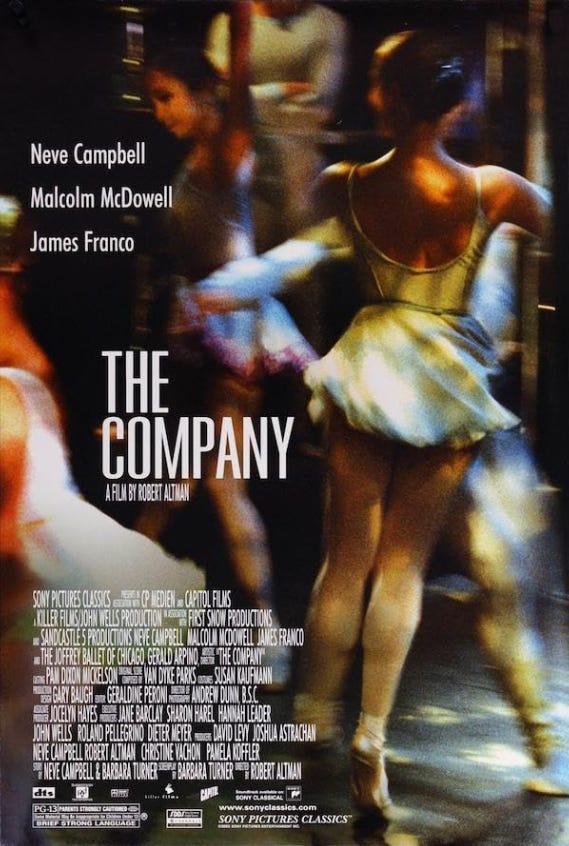
It takes a lot of money to make pictures, so I would say that most of the films that I have done have been what I could do. I don’t know what I would have done if they’d just said, “Well, do what you want to do.”
Robert Altman, Altman on Altman
The series so far:
Introduction, Countdown, and That Cold Day in the Park
McCabe & Mrs. Miller and Images
The Long Goodbye and California Split
Nashville and Buffalo Bill and the Indians, or Sitting Bull’s History Lesson
Come Back to the Five and Dime, Jimmy Dean, Jimmy Dean and Streamers
Secret Honor and Fool for Love
The Gingerbread Man and Dr. T & the Women
Movies, Now More Than Ever! three filmmakers on Robert Altman
Robert Altman on the Criterion Channel
When I think of ballet movies, my mind goes to The Red Shoes (1948) and its granddaughter Black Swan (2010): psychological dramas about the obsessive pursuit of perfection and the fatal collision of art and life.
The Company is a kinder, gentler ballet movie, directed by a man in his late seventies as his penultimate film.
Late style is a somewhat nebulous, somewhat contested idea in fields like art history and literary criticism. In probably its most common form, it refers to artists making more serene, meditative, pared-down work in their last years.
For me, cinema’s great example of this is The Dead (1987), the Joycean adaptation directed by a terminally ill John Huston in his last months. It’s Huston’s quietest film, a film ultimately about death and how the dead live on in the memory of the living.
The Company is not on that level, but it does represent late Altman, Altman and company very much working in a late style. Instead of melodrama, Michael Joshua Rowin calls it a “mellow drama:”
Altman shoots The Company with a grace and lightness befitting its subject matter, allowing the Joffrey’s rehearsals, board meetings, and costume changes to unfold as naturally as a perfect pirouette.
‘Mellow,’ ‘grace,’ ‘lightness,’ and ‘naturally’ are perfect words to describe this project.
After Gosford Park, Robert Altman began work on a project he once intriguingly, enigmatically described as a movie “about a bear” starring Paul Newman and Naomi Watts.1 But that project fell apart due to the machinations of Harvey Weinstein and Altman signed on to a project from an unlikely source, scream queen Neve Campbell.
After the success of the Scream movies, Campbell wanted to star in a more personal project, one inspired by her formative experiences at the National Ballet School of Canada. Altman’s friend and associate Barbara Turner2 — a colleague from his sixties television days — expanded Campbell’s idea into a script and pitched it to Altman, who was Campbell’s first choice to direct.
While Altman knew very little about ballet, he was a filmmaker fascinated by artists and performers, by the drama and comedy that occurs when a group of characters put on a show. His filmography represents almost a catalogue of different forms of media, from filmmaking itself to painting, country music, Buffalo Bill’s Wild West show, haute couture, jazz and radio broadcasting.
The Company is a film very much in this lineage. As the title suggests, its focus is the entire ballet company, Chicago’s Joffrey Ballet, which had inspired Turner’s script. Before Turner, Campbell had turned down several treatments about, as Altman describes them, “the poor little girl who struggles to become a ballerina and finally makes it.” Campbell wasn’t interested in making that kind of movie and neither was Altman.
Instead, the opening credits list the cast as Campbell, Malcolm McDowell, James Franco and the Joffrey Ballet of Chicago, which is exactly right. The ballet company itself is a main character; instead of following a protagonist’s narrative arc, the film follows the process of putting on a ballet, from meetings with the choreographer to rehearsal, dressing rooms, afterparties, fundraising dinners, performances, analyzing and critiquing performance footage, and dealing with injuries. In the film’s funniest moment, real-life Joffrey Ballet choreographer Robert Desrosiers pitches a new ballet to the dancers with the unforgettable hook “we start with a giant snake onstage.”
At the center of everything is McDowell’s Alberto Antonelli, a character inspired by Joffrey Ballet artistic director Gerald Arpino. McDowell has of course been typecast as a villain for decades, so it’s nice to see him play a very different character: a hardworking, sometimes prickly leader determined to keep the company operating despite financial challenges. Campbell is also good as the film’s protagonist, while Franco is her love interest in a minor subplot. But those three names are really the only actors in the film.
During preproduction, Altman and company faced the dilemma of hiring actors to dance vs. hiring dancers to act. Altman decided on the latter, reasoning that they were already experienced, disciplined performers who could adapt to a new challenge.
And they weren’t the only ones. Almost a half-century into his career as a director, Altman took on the new challenge of digital cinema. Cinematographer Andrew Dunn used a Sony HDW-F900, the same camera George Lucas had used for Star Wars: Episode II – Attack of the Clones (2002); The Company is one of the first major American films shot entirely on digital.
These “light, cheap, digital cameras,” Rowin writes,
record performances for extended periods of time… the possibility of quick retakes is absolutely essential for shooting dancers physically prohibited from waiting around and cooling off while a crew reloads for another run.
This sounds like documentary filmmaking, and if I had one major critique of The Company it would be that — as good as Campbell and McDowell are — I would have loved to see an Altman documentary about the Joffrey Ballet rather than a documentary-style drama. Altman was always up to try to new challenges, from tv miniseries to concert specials to opera, and his aesthetic and approach would have served him well in documentary.
But The Company is the closest we’ll ever get to a theatrical Altman documentary feature, and probably the best thing about is that it’s a fictional film that has a lot of the aesthetic pleasures of a fly-on-the-wall documentary.
The Company premiered in September 2003 at the Toronto International Film Festival. Sony Pictures Classics gave it a limited release in December and, like many of Altman’s films, it underperformed at the box office. Todd McCarthy of Variety gives a good explanation in his review. The Company, he writes, eschews the “customary elements” of the backstage ballet movie — “the hysteria, imperious company manager, cruel choreographers, prima donnas, furious rivalries and everything-for-art obsessiveness” — for “an impressionistic, undramatic approach that will be too soft and uneventful for mainstream viewers.”3
Quite a few critics critiqued the film as unfocused, as lacking strong character arcs. In a 2/5 star review, for instance, Guardian critic Peter Bradshaw essentially criticizes it for offering middle class, middlebrow respectability instead of the “boldly vivid” entertainment of backstage melodrama. “The real problem with The Company,” Geoffrey MacNab writes in Sight and Sound, “is the lack of narrative drive… nothing much seems to be at stake here.”4 But McNab goes on to write that “The Company provides a subtle and absorbing insight into the inner workings of the Joffrey Ballet.”
Others read it as a veteran filmmaker reflecting on his creative process.
Slant critic Ed Gonzalez, who describes the film as a masterpiece, calls Malcolm McDowell’s character Altman’s doppelganger. Roger Ebert begins his review by asking “Why did it take me so long to see what was right there in front of my face — that The Company is the closest that Robert Altman has come to making an autobiographical film?”
“Altman has rarely had box office hits,” Ebert writes at the conclusion of his review,
and yet he has found a way to work steadily, to be prolific, despite almost always choosing projects he wants to work on. How does he do it? The Company offers some clues.
Indeed. While I’m not sure about direct autobiographical parallels, I think this film about a team of dedicated artists working together despite financial challenges does say something about Altman’s filmmaking process, about his career.
As always, my primary source for this series is the book-length interview Altman on Altman, edited by David Thompson.
Possibly best known as the mother of Jennifer Jason Leigh (who appeared in two Altman movies), Turner had her own successful career as a screenwriter, cowriting movies like the Stephen King adaptation Cujo (1983) and the Oscar-winning biopic Pollock (2000).
McCarthy, Todd. “The Company.” Variety, vol. 392, no. 5, Sept., 2003, pp. 23-24.
Macnab, Geoffrey. “The Company.” Sight and Sound, vol. 14, no. 5, May, 2004, pp. 49-50,3.