
Altmanesque 18
A Prairie Home Companion

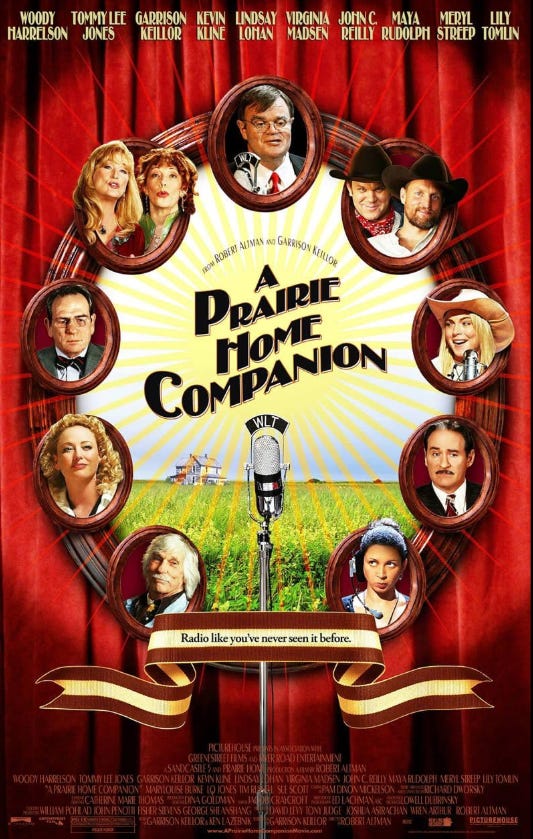
Every show’s your last show, that’s my philosophy.
Garrison Keillor, A Prairie Home Companion
The series so far:
Introduction, Countdown, and That Cold Day in the Park
McCabe & Mrs. Miller and Images
The Long Goodbye and California Split
Nashville and Buffalo Bill and the Indians, or Sitting Bull’s History Lesson
Come Back to the Five and Dime, Jimmy Dean, Jimmy Dean and Streamers
Secret Honor and Fool for Love
The Gingerbread Man and Dr. T & the Women
Movies, Now More Than Ever! three filmmakers on Robert Altman
Robert Altman on the Criterion Channel
A Prairie Home Companion (2006)
(a guest post by Holly Jones)
I’m a film school graduate, but you’d never know it. I never wound up on a set, and I can’t even find my diploma. Perhaps it was a fever dream. I’d doubt that education more, but I still recall every movie that was presented for critique during my tenure.
Robert Altman’s Nashville (1975) stands as one of the strongest pieces of cinema I was introduced to. That spry study of burgeoning Americana set me off on a course to locate his entire oeuvre, which shoved me clear into an appreciation of the director despite all of the steps he took outside of his own weathered bounds. Even a tragic or tepid Altman film has always felt gleeful to me, vibrant.
You can imagine my elation when Robert began his rich documentation of the director’s intimidating film catalogue here on Substack for Earthly Delights, pouring over nearly all of his screen gets from start to finish, fine tooth comb and a copy of Altman on Altman in hand.
This week, I’ve dedicated my time to a heartfelt rewatch of Altman’s unwitting swan song, A Prairie Home Companion (2006), in hopes of honoring his wide-eyed legacy and adding to the already robust discussion over here in the Altmanesque universe. It’s been a ponderous excursion, and I’m so glad to have joined the train as it took off from the station — onward through a few nosedives amidst each set of treasures ol’ Altman delivered.
With a scratch and a ramble, this fable begins by framing a hillside at dusk. As the sun throws a pink hue to welcome the night sky, a radio tower compliments a water tower, silhouettes that dot each side of the scene as the waves volley. Static fills the space between each change of the program — from cooking, to evangelical worship, sports to advice, and smooth jazz to a traffic report. Slowly, an aurora erases the frolicking sound as a sly transition occurs, delivering the viewer to a rain soaked street in St. Paul, neon lights dancing off a puddle outside of a timeworn diner. We’re introduced to a cityslick private eye-turned-security detail sitting at the counter within who’ll go on to offer a fly-on-the-wall account of the final broadcast of a beloved live-audience variety show.
The plot is based on the titular meteoric radio program that saturated American airwaves every Saturday night. Led by charismatic ringleader Garrison Keillor from 1974-2016, out of St. Paul’s grand Fitzgerald Theatre, the show would go on to entertain with musician Chris Thile at the helm until 2020, supported by Minnesota Public Radio via its American Public Media arm. A mix of wry storytelling, local folk acts and comedic vignettes, the show became a welcome piece of midwestern nostalgia even before it was officially off the air.
Keillor courted Altman while he was shooting The Company (2003) in Chicago. Once locked, he’d go on to write the script alongside Ken LaZebnik and play himself in the film, which is as true a rendition of communal mayhem as possible. The scenes merge a stacked ensemble cast with professional musicians and the spirit of the broadcast is quickly established: chaotic, charming, arresting and unique, a crew of lofty artists palling around and giving audiences a taste of that same camaraderie, cultivating a sense of community. The true-life program that enraptured a steady listener base for ages was an apt canvas, and Altman filled it with astounding levity as he sketched intriguing portraits of grief, death, greed and togetherness over one boundless hootenanny of a farewell.
In addition to showcasing this rich history, a mischievous former listener-turned-harbinger and a hushed on-set death divert audience intrigue backstage; both subplots add suspense and whimsy that play like noir sidecars to the spirited performance numbers.
Altman’s behemoth of a cast is allowed to roam, and they repay him in kind by abiding his auteur mandates — both explicit and implied. As in prior frenzied features, Nashville and Short Cuts (1993), Altman denies his protagonists their real-world infamy and, when looking at each actor on screen, we see their persona long before recalling the latest tabloid article they’ve been featured in. The director forms such an intimate relationship with his talent, he’s able to elicit immense character building from them without extracting any of the limelight fatigue. It seems impossible to do when you see he’s called prodigal misfit Lily Tomlin to stand aside the likes of Meryl Streep, Kevin Kline, Maya Rudolph, Tommy Lee Jones, John C. Reilly, Virginia Madsen, Woody Harrelson and Lindsay Lohan. Altman makes it appear as simple as cooking a fried egg on a preheated flattop.
Simultaneous banter reverberates through scenes like a fighter jet racing through the atmosphere at warp speed. In this, his last hoorah, the acting is immeasurably freeform, providing the sense that the viewer is at the other end of the camera cavorting with each protagonist in real-time, sifting through their minds for a needle in this astounding haystack, where each jubilant act attempts the grandest closing night imaginable to a studio audience and the dogged listeners who’ve supported them for decades.
Altman weaves a distinct thread through all of his films, though they’re each wholly different garments. For all of the spectacle A Prairie Home Companion delivers, Altman and his team injected a weighty dose of bittersweet armchair philosophy. Palpable and emotive talks on the grand ‘goodbye’ permeate nearly every scene — from a fallen peer, to a suicide-curious youngin’, a show in the shadows with nothing on the horizon for its stars. It all works to encompass the trepidation that comes with facing the inevitable: there comes a time when we all have to wind it on down, so we ought do our best to eat our toast before the butter melts. Dealing in several finales at once, the film is a near-perfect ode to a legendary radio outfit, and to the director who gave us a colossal smorgasbord of material to decipher for years to come.
 | A guest post by
|
Thanks so much Holly.
It's always sad coming to the end. Especially a film like this, which is about putting on one last show. Life imitating art.
Altman intended to make another film after this, but Prairie Home Companion is a summation of so much of his work, intentionally or not. The ensemble casts, the creative process as a subject, the interweaving narratives.